
Trump signaled at the NATO summit in Ankara today that he is prepared to sell Turkey the F-35 Lightning II - reversing a congressional ban imposed after Turkey purchased Russia's S-400 air defense system.
As a former F-15E combat pilot, I break down what is actually inside the F-35, why the S-400's multi-frequency radar arrays create a decade-long intelligence risk even if they cannot achieve weapons lock on stealth aircraft, and why Israel and 6 Republican Congressmen are openly furious.
The honest case for AND against the deal - plus: someone tried to blow up the French president in Damascus this morning.
Our Thoughts…
Turkey’s History with the F-35 Program (AI)
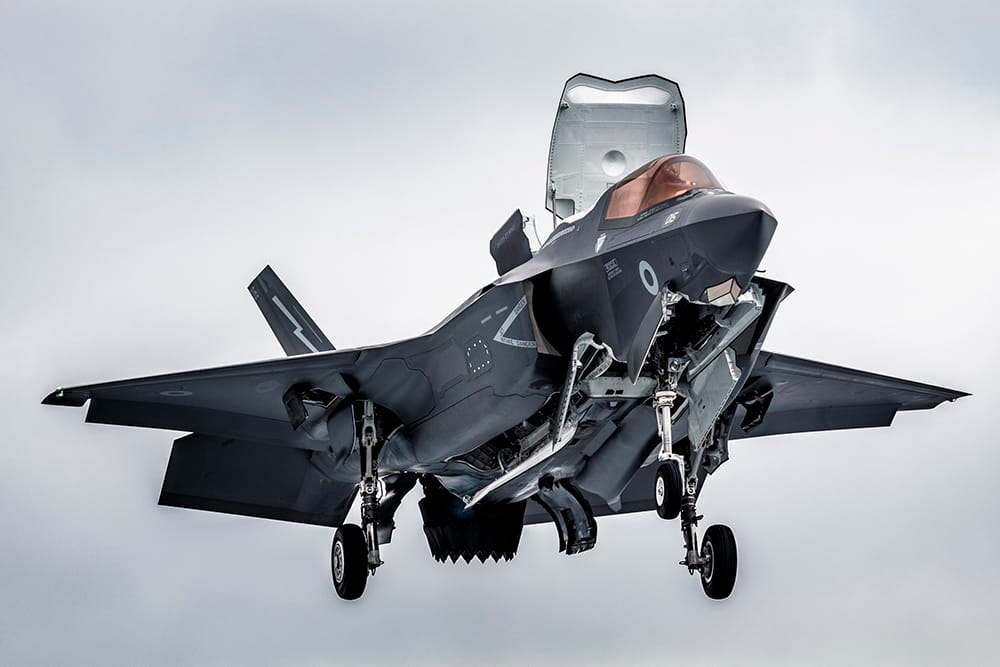
Turkey became a partner in the F-35 Joint Strike Fighter (JSF) development program in 2002 under President G.W. Bush and officially joined the production phase in 2007, planning to purchase 116 F-35 Lightning II aircraft.
As a participant, Turkey contributed approximately $175 million to the F-35’s development and its companies produced over 900 components for the aircraft, including critical parts like the fuselage and landing gear.
The first F-35 aircraft for the Turkish Armed Forces was unveiled at a roll-out ceremony in 2018 under President Trump’s 1st term.
The F-35 is described as a high-tech attack aircraft that has revolutionized air power.
In 2017, Turkey signed a deal with Russia to acquire the S-400 air-defense system, and deliveries began in 2019.
The United States warned Turkey that purchasing the S-400 would jeopardize its involvement in the F-35 program, citing concerns that the Russian system could gather intelligence on the F-35’s stealth technology and undermine NATO interoperability.
Despite these warnings, Turkey proceeded with the S-400 purchase, leading to its expulsion from the U.S.-led F-35 program in July 2019.
Congress also passed a law prohibiting F-35 sales to Turkey as long as it retained the S-400s.
Perspectives
Support for Turkey’s Re-entry to the F-35 Program
President Trump has indicated a willingness to consider selling F-35s to Turkey and lifting sanctions, emphasizing improved relations and Turkey’s loyalty.
Some believe that selling F-35s to Turkey, a NATO ally, would be a logical step given their continued interest in the jets.
Opposition to Turkey’s Re-entry to the F-35 Program
Concerns exist regarding Turkey’s reliability as a NATO partner due to its economic and military ties with Russia, its alignment with Iran, and its harboring of Hamas leadership.
U.S. law and congressional restrictions prohibit F-35 sales to Turkey as long as Ankara retains the Russian S-400 air defense system.
The sale of F-35s to Turkey could undermine Israel’s qualitative military edge in the region, a long-standing U.S. policy.
There are warnings against selling military jet engines to Turkey due to its adversarial actions under Erdogan’s leadership, including illegal military overflights of Greek islands
Turkey’s S-400 Acquisition and Repercussions (AI)
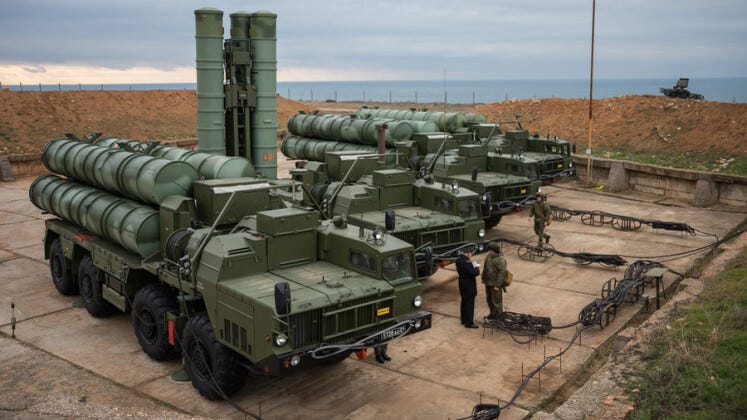
Turkey’s pursuit of a new air defense system began around 2009, leading to a verbal agreement with Russia in 2017 to purchase the S-400 missile system, an agreement formalized later that year.
This decision followed Turkey’s dissatisfaction with an earlier attempt to acquire the US-made MIM-104 Patriot air defense system, as Washington was not committed to finalizing a deal.
Turkey reportedly paid $2.5 billion for the Russian system.
The S-400 is capable of operating independently, a feature that allows Turkey to use it without integrating it into NATO’s defense network.
Turkey received the first components of the S-400 system on July 12, 2019, with four batteries, 36 fire units, and 192 or more missiles delivered by 2020.
The system was reportedly fully integrated into Turkey’s national command-and-control framework by December 2024, although it has not been activated under Turkey’s national defense strategy.
Turkey also conducted tests of the S-400’s radar against its F-16 and F-4 fighter jets in November 2020.
The United States and NATO expressed concerns that the S-400 system could compromise the F-35 stealth fighter’s security and operations, and allow Russia to gather intelligence on the F-35’s advanced capabilities.
As a result, the United States formally expelled Turkey from the F-35 program on July 17, 2019, seizing F-35s intended for Turkey and removing Turkish companies from producing parts for the jets.
This move also led to the imposition of U.S. CAATSA sanctions (Countering America’s Adversaries Through Sanctions Act) on Turkey’s Presidency of the Defense Industry in December 2020.
Despite these sanctions and objections, Turkey has maintained its possession of the S-400 system.
There have been ongoing discussions with the U.S. regarding sanctions and Turkey rejoining the F-35 program, with potential legal and political hurdles to be navigated.
Some discussions have explored the possibility of Turkey selling its S-400 systems to facilitate its return to the F-35 program or the acquisition of alternative platforms like F-16s, though as of 2025-2026, Turkey is still evaluating Western air defense systems for its national integrated air defense system.
The Board of Peace (AI)
The Board of Peace is an international body chaired by U.S. President Donald Trump, established to oversee the October 2025 ceasefire in the Israel-Hamas War.
It was proposed in October 2025 and endorsed by the United Nations Security Council the following month through Resolution 2803.
This resolution welcomed the board’s role in reconstruction efforts in the Gaza Strip and authorized it to deploy a temporary peacekeeping force.
The Board of Peace was formally launched in January 2026, with its charter ratified in Davos, Switzerland.
Its initial mission was to provide strategic oversight, mobilize international resources, and manage Gaza’s transition from conflict to development following the ceasefire.
The board is also tasked with supervising a transitional Palestinian technocratic government in the Gaza Strip, known as the National Committee for the Administration of Gaza (NCAG), and aims to disarm Hamas while training a new Palestinian police force through an International Stabilization Force (ISF).
Permanent member status on the Board of Peace reportedly costs as much as $1 billion, and participating countries are required to contribute this amount to renew membership after the first 3 years.
The board held its inaugural meeting in Washington, D.C., where it discussed the reconstruction of Gaza and the funds pledged by member states.
As of February 2026, 26 countries have been designated as founding members, with some countries like the UAE, Morocco, Vietnam, Hungary, and Argentina committed to joining.
Perspectives
Expanded Mandate and Potential Rival to the UN
While the Board of Peace was initially focused on Gaza, its charter describes it as an international organization promoting stability, peace, and governance in any area affected or threatened by conflict, suggesting a broader global mandate beyond Gaza.
President Trump, who serves as the chairman for life, has suggested that the Board of Peace may eventually supersede the United Nations and stated that its potential goes far beyond Gaza, aiming for “WORLD PEACE!”.
This expanded mandate and Trump’s position as chairman for life, with sole authority to invite or remove member states and break any vote, have led some to view the board as an attempt to establish an alternative to the United Nations.
Concerns Regarding Membership and Legitimacy Are Mostly from Legacy Sovereignty
The Board of Peace has attracted a controversial mix of world leaders, including some from countries that might once have been called an “axis of evil,” and has raised alarm due to the potential inclusion of Russia and Belarus.
Democratic allies such as the UK, Canada, France, and Germany are notably uninvolved in the board, and there is no Palestinian representation despite the board’s focus on Gaza, while Israel is a founding member.
Critics express skepticism about the board’s legitimacy and purpose, with some questioning who elected Trump as chairman and whether it is a “blatant power grab” that could undermine existing international institutions [as if someone else would be better suited? He’s stopped EIGHT wars, for the love of God].
Turkey’s Involvement with the Board of Peace (AI)
Turkey has joined the Board of Peace, an international initiative introduced by President Donald Trump.
Turkey’s Foreign Minister Hakan Fidan signed the Board of Peace charter in Davos, Switzerland, on January 22, 2026. President Recep Tayyip Erdogan accepted Trump’s invitation for Turkey to join the Board of Peace, with Fidan representing Turkey at the inaugural meeting.
The Board of Peace was initially conceived to oversee the Gaza peace process and the reconstruction of Gaza, but its mandate has since expanded to address global conflicts.
Turkey views its participation as valuable for promoting peace and stability, particularly in Palestine and Gaza.
Foreign Minister Fidan is also a member of the Gaza Executive Board, a subsidiary body of the Board of Peace tasked with overseeing the Gaza ceasefire and reconstruction.
Despite Turkey’s membership and expressed willingness to contribute, its role in the Board of Peace, particularly regarding the International Stabilization Force (ISF) for Gaza, has been a point of contention.
During a February 19 summit, Turkey was not listed among the Muslim-majority states committing troops to the ISF, even though Fidan indicated Ankara was prepared to provide troops. Israeli officials have expressed disapproval of including partners they view as hostile, such as Turkey, in the governance of Gaza.
However, the Trump administration has welcomed Turkey’s membership, believing Ankara can play a positive role in Gaza’s reconstruction.
Perspectives
Turkish Perspective on the Board of Peace
Turkey’s President Recep Tayyip Erdogan accepted President Donald Trump’s invitation to join the Board of Peace, with Foreign Minister Hakan Fidan representing Turkey at the inaugural meeting.
Turkish Foreign Minister Hakan Fidan stated that Ankara values the efforts being made for peace in Palestine and Gaza, and views the Board of Peace as a valuable development despite potential shortcomings.
Turkey’s Foreign Minister Fidan also stated that the Board of Peace offers a “historic opportunity” to alleviate suffering, meet humanitarian needs, and establish lasting peace in the region.
Turkey remains ready to support the planned Gaza task force and has offered to send experts to help find remaining bodies in Gaza.
Concerns and Limitations Regarding Turkey’s Role
Israeli officials have signaled disapproval of including certain partners, such as Turkey, whom they view as hostile or ideologically aligned with Hamas, arguing that any governance structure must preserve Israel’s security red lines.
Despite Turkey’s insistence that it is prepared to provide troops for the International Stabilization Force (ISF) in Gaza, it was notably absent from the list of Muslim-majority states formally committing troops.
One perspective suggests that Turkey’s role on the Gaza Peace Board should be limited to humanitarian aid delivery until Ankara verifiably dismantles Hamas’s infrastructure in Turkey and ends support for terrorism.
Turkey implemented new measures to block trade with Israel, which some sources suggest creates a paradoxical outcome given its logistical role in the Board of Peace for Gaza’s reconstruction.
President Trump’s Forward Thinking (AI)
President Trump has emphasized the importance of forward-looking strategies in various aspects of his presidency, including diplomacy, federal workforce policy, and economic planning.
He has stated that his administration is focused on advancing American artificial intelligence innovation and security, aiming to strengthen cybersecurity and protect critical infrastructure, asserting that he is the most forward-leaning President on innovation in American history.
Additionally, his administration has indicated a focus on bringing back jobs, lowering taxes, and reducing regulations as part of a forward-looking economic plan.
President Trump has also discussed the concept of thinking big and moving forward, advising against stagnation and encouraging action and aiming high.
He has advocated for making the “next right decision” in uncertain circumstances.
He has frequently referenced and defended his cognitive abilities, mentioning having “aced” cognitive tests, and speaking about his mental and physical well-being.
Trump’s forward-thinking approach is seen as strategic and beneficial for the nation.
Trump’s administration is characterized by forward-thinking diplomacy aimed at creating a new world dynamic that promotes peace and accountability.
He is considered the most forward-leaning President on innovation in American history, particularly in advancing artificial intelligence and cybersecurity.
His strategic flexibility and unpredictability in decision-making have kept world leaders off balance, which some view as a strategic asset.
Trump’s strategic thinking emphasizes careful consideration of military actions and their broader implications, aligning with an “America First” approach that resonates with a growing movement.
[personal note from the editor - the sources for the following perspectives are continuously divisive and shot-sited, sometimes even envious]
Concerns exist regarding the potential risks and implications of Trump’s forward-thinking approach, with some questioning its basis and long-term effects
Trump’s evolving foreign policy, driven by past successes, raises concerns about potential reckless decisions in the future.
His “wishful thinking” has been cited as a factor in certain foreign policy decisions, with calls to acknowledge uncomfortable realities
Some observers question the information guiding President Trump’s decisions, despite confidence in his intentions.
There are concerns that Trump’s presidency could mark a shift from progress to a focus on protection, with potential for significant damage to domestic and international structures.
Some analyses suggest Trump’s approach is not always forward-looking, but rather aims to reverse previous policies or consolidate power.
Trump has endeavored to reverse globalization and internationalism that defined U.S. leadership for decades, and has aimed to undo changes that happened years or even decades prior.
His strategic vision is seen by some as aiming to deploy National Guard troops in blue cities to intimidate voters and influence elections, reflecting a tactical advantage over the Democratic Party.
Trump’s use of emergency powers to bypass legislation and his expansion of presidential powers are noted as significant departures from past presidential behaviors
Not As Simple As the MSM Headlines Are Making It Look
It is actually a 7-year timeline…
Final Word
There IS a lot of dust being stirred up with this move to give Turkey F-35s - but we are also NOT in the times of British Imperial leveraging itself through Henry Kissinger, Edmund Muskie, Madeline Albright, Condaleeza Rice, Hillary Clinton, John Kerry, and a plethora of other British diplomat slaves.
The ways and means of the old dominated by the rules created by the British Empire are now dead - and the ways and means now are focused on the American system that was once dominant up until the early 1900s (2924 to be precise).


ADDENDUM 8 Jul 2026
Thanks to ForeignLocal for bringing their post to our attention…
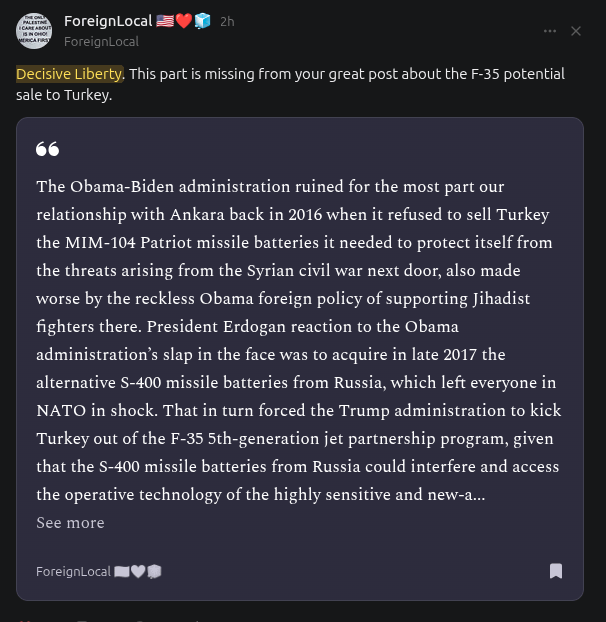
Click below for their full post…