

(Our Note: Poor image creation - we are NOT f#cked, fearmongering by the image creator; and the circled item is not what was discovered.)
More than 15 billion miles from Earth, beyond the heliopause where the Sun’s influence fades into the interstellar medium, Voyager 1 drifts through what scientists once described as quiet, uniform, and predictable space. Temperatures near absolute zero.
Matter so sparse that even a single hydrogen atom feels present.
No planetary gravity.
No solar wind turbulence.
Just the cold, silent abyss between stars.
And yet, in that silence, something moved.
Not a planet.
Not an asteroid.
Not a comet.
Not dust.
Voyager’s plasma wave instrument - never designed to detect moving objects - picked up fluctuations.
Frequency shifts.
Variations in intensity.
Directional changes.
The signal was not random noise.
It was not a fleeting glitch.
It persisted long enough and varied consistently enough to indicate something dynamic in its environment.
What makes the finding unsettling is not just the detection itself.
It is where it happened.
Beyond the heliopause, in a region where almost nothing should be happening at all.
Let’s begin with the movement…
About Voyager 1
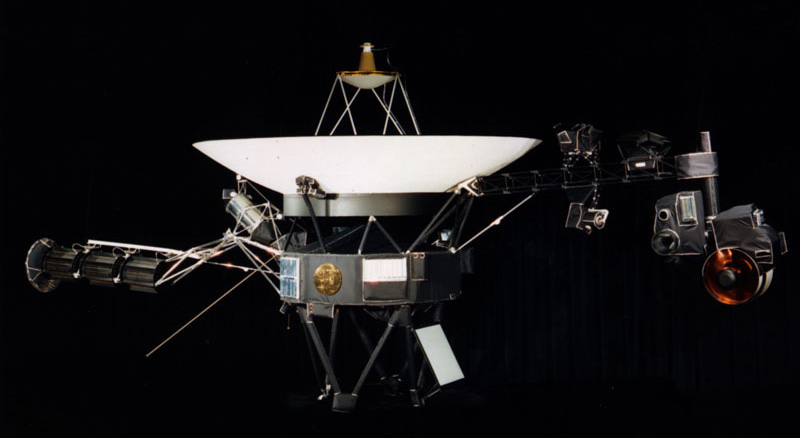
NASA's Voyager 1 is a robotic space probe launched on September 5, 1977, as part of the Voyager program, designed to explore the outer solar system and interstellar space.
It was launched 16 days after its twin, Voyager 2.
Weighing approximately 1,797 pounds at launch, the probe is roughly the size of a small car and carries a 12-foot-wide dish antenna for communication with Earth.
Voyager 1's mission has included flybys of Jupiter and Saturn, providing detailed images of their moons, rings, and magnetic fields.
It was the first spacecraft to reveal active volcanoes on Jupiter's moon Io and offered close-up studies of Saturn's rings and its moon Titan.
Voyager 1 is the most distant human-made object from Earth, having traveled over 14 billion miles (23 billion kilometers) from the Sun.
It became the first spacecraft to enter interstellar space in August 2012, with this milestone confirmed in 2013 by plasma measurements.
As of August 2026, its distance is 172.59 AU (Astronomical Units; 25.8 billion km; 16.0 billion mi).
Voyager 1 is projected to reach a distance of one light-day from Earth, approximately 25.9 billion kilometers (16.1 billion miles), in November 2026, marking another historic first.
The probe continues to transmit data to Earth through the NASA Deep Space Network, with signals currently taking over 22 hours to reach it.
Despite its age and dwindling plutonium power supply, only a few of its instruments remain operational, but engineers continue to work on extending its lifespan through power management procedures.
On April 17, 2026, NASA engineers shut down Voyager 1's Low-energy Charged Particles (LECP) experiment to conserve power, a move expected to extend the spacecraft's operational life by about a year.
This instrument had been operational almost continuously since the probe's launch in 1977, providing critical data on the interstellar medium.
Voyager 1 also carries a Golden Record, a gold-plated copper phonograph disc containing sounds of Earth, greetings in 55 languages, musical compositions, and encoded images of terrestrial life, intended as a message for any extraterrestrial life it might encounter.