
The First Continental Congress convened in Philadelphia in 1774, gathering delegates from twelve of the thirteen American colonies - if the British had found out about it, there would have been hangings.
It met from September 5 to October 26, 1774, in Carpenters' Hall, in response to British Parliament's enactment of the Coercive Acts, also known as the Intolerable Acts.
These acts were imposed after the Boston Tea Party to punish Massachusetts and reassert British dominance over the American colonies.
The primary goal of the Congress was to coordinate a unified colonial response to these acts, with many delegates still hoping for reconciliation with Britain rather than immediate independence.
During the seven-week gathering, 56 delegates, including prominent figures like Samuel Adams, John Adams, and George Washington, discussed various options, such as a boycott of British imports and the establishment of their own military force.
On October 14, the Congress issued the Declaration and Resolves, which outlined the rights of the colonists and objected to British rule, particularly the Coercive Acts.
They also established the Continental Association, which called for a suspension of trade with Great Britain to exert economic pressure.
The Congress made plans to reconvene as the Second Continental Congress in May 1775 if their grievances were not addressed, setting the stage for future actions that would lead to the American Revolution.
One of the first official acts of the First Continental Congress on September 7, 1774, was to hold a prayer meeting led by Reverend Jacob Duché.
Samuel Adams supported the idea, suggesting Duché, an Episcopalian pastor, to lead the prayer, which helped foster unity among the delegates from various denominations.
The prayer sought divine guidance and support for the American states in their struggle against oppression.
Convocation Prayer of the First Continental Congress
Author: Jacob Duché
Date: September 7, 1774
“O Lord our Heavenly Father, high and mighty King of kings, and Lord of lords, who dost from thy throne behold all the dwellers on earth and reignest with power supreme and uncontrolled over all the Kingdoms, Empires and Governments; look down in mercy, we beseech Thee, on these our American States, who have fled to Thee from the rod of the oppressor and thrown themselves on Thy gracious protection, desiring to be henceforth dependent only on Thee.
“To Thee have they appealed for the righteousness of their cause; to Thee do they now look up for that countenance and support, which Thou alone canst give.
“Take them, therefore, Heavenly Father, under Thy nurturing care; give them wisdom in Council and valor in the field; defeat the malicious designs of our cruel adversaries; convince them of the unrighteousness of their Cause and if they persist in their sanguinary purposes, of own unerring justice, sounding in their hearts, constrain them to drop the weapons of war from their unnerved hands in the day of battle!
“Be Thou present, O God of wisdom, and direct the councils of this honorable assembly; enable them to settle things on the best and surest foundation.
“That the scene of blood may be speedily closed; that order, harmony and peace may be effectually restored, and truth and justice, religion and piety, prevail and flourish amongst the people.
“Preserve the health of their bodies and vigor of their minds; shower down on them and the millions they here represent, such temporal blessings as Thou seest expedient for them in this world and crown them with everlasting glory in the world to come.
“All this we ask in the name and through the merits of Jesus Christ, Thy Son and our Savior. Amen.”
Source: “First Prayer of the First Continental Congress, 1774” Website of the U.S. House of Representatives, Office of the Chaplain, last accessed November 1, 2016.
John Adam’s Letter to His Wife Abigail on the Impact of Duché’s Prayer
Page 1
Phyladelphia Septr. 16, 1774
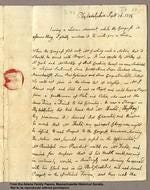
Having a Leisure Moment, while the Congress is assembling, I gladly embrace it to write you a Line.
When the Congress first met, Mr. Cushing made a Motion, that it should be opened with Prayer. It was opposed by Mr. Jay of N. York and Mr. Rutledge of South Carolina, because we were so divided in religious Sentiments, some Episcopalians, some Quakers, some Aanabaptists, some Presbyterians and some Congregationalists, so that We could not join in the same Act of Worship.-Mr. S. Adams arose and said he was no Bigot, and could hear a Prayer from a Gentleman of Piety and Virtue, who was at the same Time a Friend to his Country. He was a Stranger in Phyladelphia, but had heard that Mr. Duche (Dushay they pronounce it) deserved that Character, and therefore he moved that Mr. Duche, an episcopal Clergyman, might be desired, to read Prayers to the Congress, tomorrow Morning. The Motion was seconded and passed in the Affirmative. Mr. Randolph our President, waited on Mr. Duche, and received for Answer that if his Health would permit, he certainly would. Accordingly next Morning he appeared with his Clerk and in his Pontificallibus, and read several Prayers, in the established Form; and then read the
Page 2
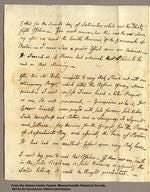
Collect for the seventh day of September, which was the Thirty fifth Psalm. -You must remember this was the next Morning after we heard the horrible Rumour, of the Cannonade of Boston.-I never saw a greater Effect upon an Audience. It seemed as if Heaven had ordained that Psalm to be read on that Morning.
After this Mr. Duche, unexpected to every Body struck out into an extemporary Prayer, which filled the Bosom of every Man present. I must confess I never heard a better Prayer or one, so well pronounced. Episcopalian as he is, Dr. Cooper himself never prayed with such fervour, such Ardor, such Earnestness and Pathos, and in Language so elegant and sublime-for America, for the Congress, for The Province of Massachusetts Bay, and especially the Town of Boston. It has had an excellent Effect upon every Body here.
I must beg you to read that Psalm. If there was any Faith in the sortes Virgilianae, or sortes Homericae, or especially the Sortes biblicae, it would be thought providential.
Page 3
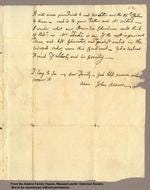
It will amuse your Friends to read this Letter and the 35th. Psalm to them. Read it to your Father and Mr. Wibirt.-I wonder what our Braintree Churchmen would think of this?-Mr. Duche is one of the most ingenious Men, and best Characters, and greatest orators in the Episcopal order, upon this Continent-Yet a Zealous Friend of Liberty and his Country.
I long to see my dear Family. God bless, preserve and prosper it.
Adieu.
John Adams