

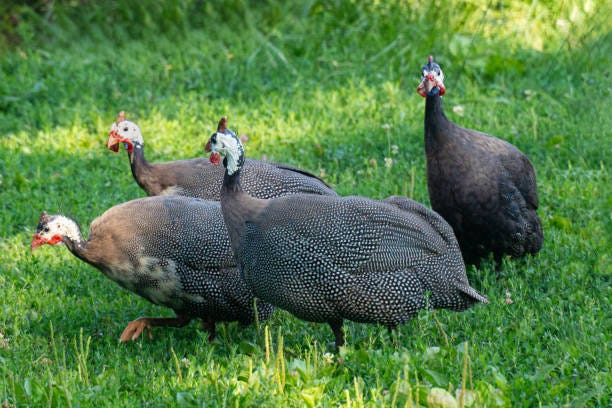
Americans have started deploying Guinea hens, notorious for their tick-hunting abilities, to their backyards.
This comes right after news that hundreds of millions of genetically modified ticks that allegedly cause lifelong illness were released into the wilderness.
This does NOT reduce the chances of getting Alpha-gal Syndrome!
Alpha-gal syndrome (AGS) is a potentially life-threatening allergy to a sugar molecule called alpha-gal, which is found in most mammals but not in humans or some primates.
This syndrome can develop after a person is bitten by a tick, most commonly the Lone Star tick in the United States.
When a tick bites an animal that carries alpha-gal and then bites a human, it can transmit this sugar molecule into the human bloodstream, causing the immune system to produce antibodies against it.
Subsequent consumption of red meat or other mammalian products can then trigger an allergic reaction.
Symptoms of alpha-gal syndrome typically appear hours after consuming red meat or mammalian products,
which can make it difficult to connect the reaction to the food.
These symptoms can include hives, nausea, abdominal pain, stomach cramps, vomiting, diarrhea, swelling of the tongue, and in severe cases, anaphylaxis.
There is currently no definitive cure or specific treatment for AGS; however, patients can manage the condition by strictly avoiding foods and products containing alpha-gal, such as beef, pork, lamb, venison, and sometimes dairy.
Some individuals may be prescribed an EpiPen for severe reactions, and avoiding further tick bites is crucial as continued exposure can exacerbate the allergy.
Researchers have documented what is believed to be the first death directly linked to alpha-gal syndrome in a 47-year-old New Jersey man.
This individual experienced severe illness after eating a steak and later died after consuming a hamburger.
The increasing prevalence of the Lone Star tick, possibly due to factors like a growing deer population, is raising awareness about this allergy, which has affected over 100,000 people in the U.S. since 2010, with some estimates suggesting as many as 450,000 people may be impacted.
Perspectives
Bioethical Implications of AGS
A paper in the journal Bioethics proposed that if eating meat is morally impermissible, then efforts to prevent the spread of tick-borne Alpha-Gal Syndrome (AGS) are also morally impermissible.
Some have suggested using the Lone Star tick to spread AGS as a condition that causes a severe but nonfatal red meat allergy.
Florida Governor Ron DeSantis publicly rejected the idea of engineering humans to develop a red meat allergy, linking it to organizations like the World Economic Forum (WEF) and the World Health Organization (WHO).
Conspiracy Theories about AGS and Ticks
The emergence of beef allergies linked to tick bites is part of a conspiracy involving individuals like Bill Gates and historical manipulation of diseases by the CIA.
The spread of Alpha-Gal Syndrome and the Lone Star tick is a deliberate effort to reduce meat consumption among the population, possibly due to environmental concerns like cow flatulence.
Bill Gates has been accused of open-air testing ticks with Lyme disease and an added pathogen to induce beef allergies, contributing to the explosion of the Lone Star tick (our note: more likely NOT a conspiracy)
Guinea fowl, often referred to as guinea hens, are hardy birds related to chickens and partridges, though they possess distinct characteristics.
They are often compared to turkeys due to their partridge-like bodies and bald heads.
These birds are known for their effective pest control, consuming ticks, fleas, mosquitoes, and other insects, as well as small animals like shrews, mice, lizards, and snakes.
Guinea fowl are also valued for their eggs, which are noted for having incredibly deep orange yolks and thicker shells than regular chicken eggs, with a flavor that some describe as superior.
Some varieties, like the French guinea fowl, are selectively bred for meat, offering a flavor often compared to pheasant or described as a richer-tasting chicken.
While beneficial for pest control and egg production, guinea hens are also known for being loud and can be a handful to manage.
They are described as noisy, alert, and relentless in patrolling their territory, acting as effective guard animals by sounding alarms when human or animal intruders approach.
They are social, often moving in groups, and prefer to roost in trees or high places, utilizing their ability to glide-fly considerable distances.
When raising guinea fowl, particularly keets (young guinea fowl), they can be trained to recognize their keeper and home territory.
They can also coexist with chickens without negative interactions, and broody chicken hens can successfully incubate and raise guinea keets.
Guinea hens lay seasonally, typically from March or April until October, producing around 100 eggs per year until they are about five years old.
Their incubation period is 26 to 28 days.
Guinea hens are not generally considered good mothers and are known to abandon nests, though guinea fowl parents together can be effective in tending to keets.
For egg production, providing nest boxes is recommended, and confining hens until noon can encourage them to lay inside.
Guinea keets require a higher protein starter feed (24-26%) than chickens, which is then reduced to 18-20% and later to a 16% layer mash.


