
Battles of Lexington and Concord
Pretext
Thomas Gage was appointed Royal Governor of Massachusetts in 1774 and tasked by the British Parliament with stamping out rising unrest caused by restrictive British policies.
Gage inflamed tensions between the colonies and the mother country and practiced harsh enforcement of British law.
He drafted the Coercive Acts, a series of laws intended to punish colonists for deeds of defiance against the King, such as the Boston Tea Party.
By April 1775, Gage was facing the threat of outright rebellion.
He hoped to prevent violence by ordering the seizure of weapons and powder being stored in Concord, Massachusetts, 20 miles northwest of Boston but he underestimated the courage and determination of the colonists.
Patriot spies got wind of Gage’s plan and on the evening of April 18, Paul Revere and other riders raised the alarm that British regulars were on their way to Concord.
Minute Men and militias rushed to confront them early on April 19.
April 19, 1775, 4:50 am Boston Time
The Battle of Lexington, on April 19, 1775, marked the beginning of the American Revolutionary War and the first major military engagements between the British Army and Patriot militias from the Thirteen Colonies.
British General Thomas Gage dispatched 700 to 800 British regulars from Boston to Concord, Massachusetts, with the goal of seizing colonial weapons and gunpowder and arresting colonial leaders Samuel Adams and John Hancock.
Patriot spies, including Paul Revere and William Dawes, rode to warn the militias of the approaching British troops, who marched through the night to reach Lexington by dawn.
Upon arriving in Lexington, the British troops encountered a militia company of more than 70 men, led by Captain John Parker, gathered on the village green.
Captain Parker, a veteran suffering from tuberculosis, reportedly told his men to
"Stand your ground. Don't fire unless fired upon. But if they mean to have a war, let it begin here."
As the two sides faced each other, a shot rang out, though historians still debate who fired the first shot, often referred to as "the shot heard 'round the world."
The British soldiers then fired a volley, resulting in 8 American colonists killed and 10 wounded.
The British subsequently gave 3 cheers and continued their march to Concord.
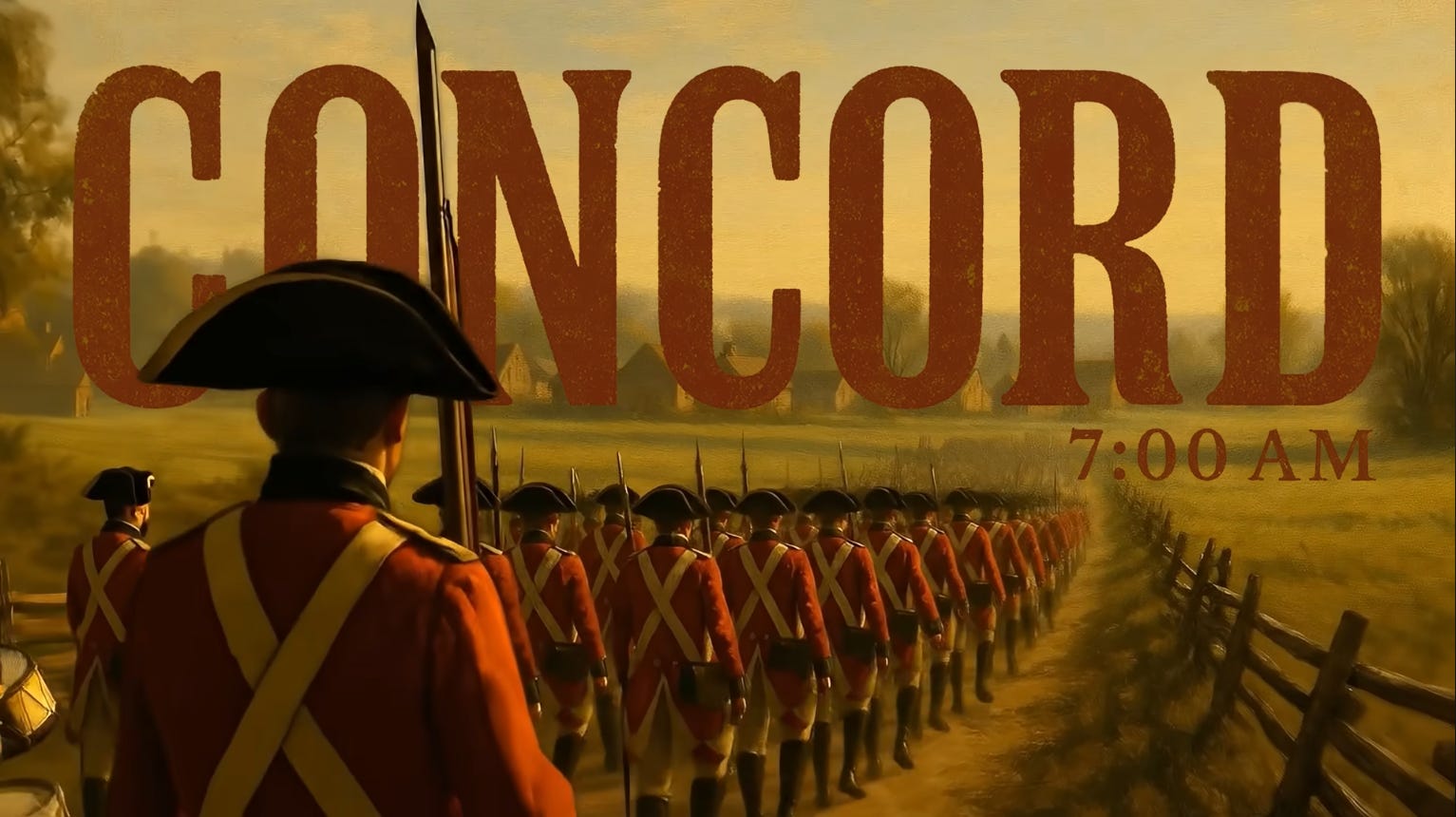
April 19, 1775, 7 am Boston Time
Following the exchange in Lexington, the British continued their march to Concord.
In Concord, the British forces searched for and destroyed some military supplies (and hence why we have a Second Amendment, which ends with “… shall not be infringed.”).
However, colonial militiamen, numbering around 400, gathered near the North Bridge and engaged the British, forcing them to retreat.
The British then faced continuous attacks from colonial militias along their return march to Boston, employing guerrilla tactics from behind cover.
The battles resulted in significant casualties: 49 colonists were killed, 39 wounded, and 5 missing.
The British suffered 73 killed, 174 wounded, and 26 missing.
These engagements demonstrated to the British that American citizen-soldiers were capable of resisting regular forces, and they are regarded as a major military victory for the colonists.
The events at Lexington and Concord are considered a crucial turning point, fueling support for independence across the colonies and leading to the subsequent siege of Boston.
The Aftermath
The British conduct a running fight until they can reach the cover of British guns on ships anchored in the waterways surrounding Boston. The Patriots chase them but, having no clear orders, ultimately let them escape.
In the wake of Lexington and Concord, Governor Gage finds Boston faced by a huge militia of men who have arrived from throughout New England to fight for liberty. Numbering 20,000, this resolute force will become part of the Continental Army.
Eight years of war followed, and those who stood their ground against Gage’s troops eventually earned independence from Britain and became citizens of the republic with democratic process called the United States of America.