
The world's strategic oil reserves have dropped to their lowest level since 1983.
President Trump said at the G7 summit: "We run out of reserves at about 4 weeks. It would be bedlam."
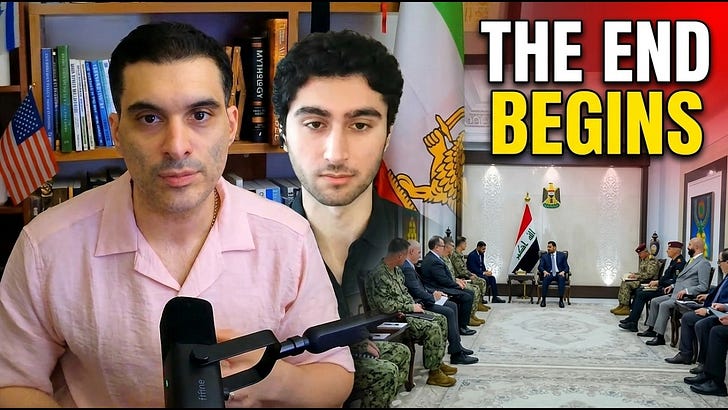
Professor Robert Pape, who has been modelling the Iran war for 20 years and has advised every White House since 9/11, says that trajectory has not changed.
The iceberg is still ahead, and there are not enough lifeboats for everybody.
He starts by showing why the US cannot simply destroy Iran's drone and missile capability.
He holds up an image of a Shahed 136 drone next to a car to show the scale.
These drones fit in a single room.
They could be anywhere in an area 1.5 times the size of California.
The terrain is mountainous, making it a three-dimensional problem, not two-dimensional.
He builds a physical model on camera, layering drones into terrain and then covering them with more terrain until they disappear.
When Steven suggests it's like trying to find a truck in California, Pape confirms: that is exactly the scale of the problem.
Iran was making 55,000 of these drones per year before the war and has likely produced thousands more since April.
Even if the US found and destroyed every drone, shipping companies would not send their vessels through the Strait of Hormuz.
Each tanker crossing the Strait carries between 700,000 and over a million barrels of oil.
A single ship is a floating asset worth $300 million.
The Pentagon cannot order private shipping companies to sail through a war zone.
The crews would mutiny.
Discover:
• Why finding Iran's drones is like trying to find a truck in California
• How each oil tanker crossing the Strait of Hormuz is a floating asset worth $300 million
• Why the US strategic oil reserve has dropped to its lowest level since 1983
• How the Houthis just shut down the Red Sea oil pipeline hours before this recording
• Why President Trump said "we run out of reserves at about four weeks, it would be bedlam"
• The fork in the road: global economic crisis or letting Iran control Hormuz
• Why the midterm elections in three months are driving military decisions
• The Titanic metaphor and why "there's not enough lifeboats for everybody"
Full Interview
Chapters
00:00:00 Intro
00:02:42 Why Robert Pape Isn't Surprised
00:04:24 Why the US Blocked the Strait of Hormuz
00:05:43 The Secret JD Vance Peace Deal (MOU)
00:08:33 Iran as Regional Hegemon, Explained
00:10:00 How Do We Know This Is the Real Document?
00:21:25 Did the War Actually Make Iran Stronger?
00:22:26 The Viral Tweet: How Is Iran Still Hitting US Bases?
00:24:57 Trump Says Iran Is Destroyed - So How?
00:25:59 Where Iran Hides Its Drones ("A Truck in California")
00:29:24 Iran Is Building New Drones the Whole Time
00:32:37 Are We on the Verge of a Global Economic Crisis?
00:36:47 What "Owning the L" Would Actually Look Like
00:38:57 Trump: The US Runs Out of Oil in 4 Weeks
00:40:52 The Midterm Elections Time Bomb
00:52:33 The Vietnam Parallel: LBJ's Trap
00:55:26 Can the US Force the Strait of Hormuz Open?
01:03:27 A 70% Chance of Boots on the Ground in Iran
01:14:59 Why Invading (Not Bombing) Sparks Suicide Attacks
01:24:25 When the Two Crises Collide: A New 1960s?
01:25:21 Will Trump Lose the Midterms?
01:27:00 Is the US Running Out of Weapons?
01:29:00 What Is Trump's Real Objective?
01:34:39 Pape's Prediction for the Next Few Months
About Robert Pape
Robert A. Pape is a professor of political science at the University of Chicago, where he specializes in national and international security affairs. He is also the founding director of the Chicago Project on Security and Threats (CPOST).
His work focuses on topics such as air power, political violence, social media propaganda, and terrorism.
He has taught international relations at Dartmouth College and air power strategy for the USAF's School of Advanced Airpower Studies.
Pape's publications include…
"Bombing to Win: Air Power and Coercion in War"
"Dying to Win: The Strategic Logic of Suicide Terrorism"
"Cutting the Fuse: The Explosion of Global Suicide Terrorism and How to Stop It"
He also authors a Substack called "The Escalation Trap," which discusses the dynamics that can turn limited strikes into broader conflicts.
Pape tracks wars, political violence, and geopolitical shifts globally, aiming to identify strategic forces influencing politics, markets, and security. He has advised the White House on conflict-related issues.
Recently, Pape has discussed the concept of the "escalation trap," particularly in the context of escalating conflicts involving the United States, such as with Iran.
He has also been involved in discussions regarding political violence in America, defining it as an era of violent populism characterized by a rising tide of political violence from both the right and the left.
He highlighted an event at Busboys and Poets that gathered diverse perspectives on foreign policy, including contributions from figures like Wajahat Ali and Trita Parsi.