
Susan Kokinda discusses the implications of President Trump's nomination of Kevin Warsh as Fed chair.
This move marks the beginning of a Republican New Deal aimed at supporting Main Street over Wall Street.
Highlighting Ambassador Jamieson Greer's impactful speech at Davos, she outlines a return to the American System, rooted in Alexander Hamilton's economic principles, and a shift away from the Globalist model.
The episode dives into the historical context, comparing Trump’s strategy with that of past American leaders who championed similar economic reforms and were targeted by the British Empire.
Chapters
00:00 The Saturday Wrap-Up - Trump vs. Wall Street: The "Republican New Deal" Begins - January 31, 2026
01:39 Regime Change at the Fed
05:00 Why They Assassinated the American System
08:20 The Receipts: $18 Trillion on Main Street
Snapshots and Notes
Why are London and Wall Street in a total panic?
Thanks to President Trump, their era of free money for the elites is over.
Kevin Warsh is President Trump’s new pick for the Federal Reserve Chair.
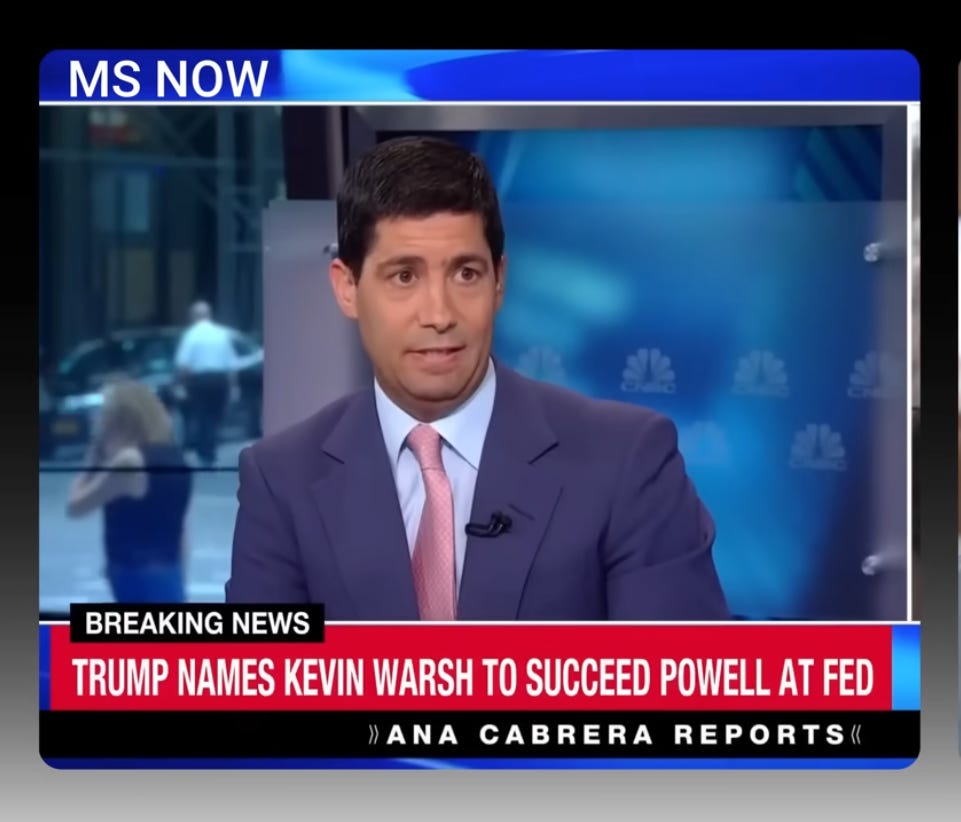
His appointment is about MUCH more than interest rates; it’s the beginning of what President Trump is calling a Republican New Deal.
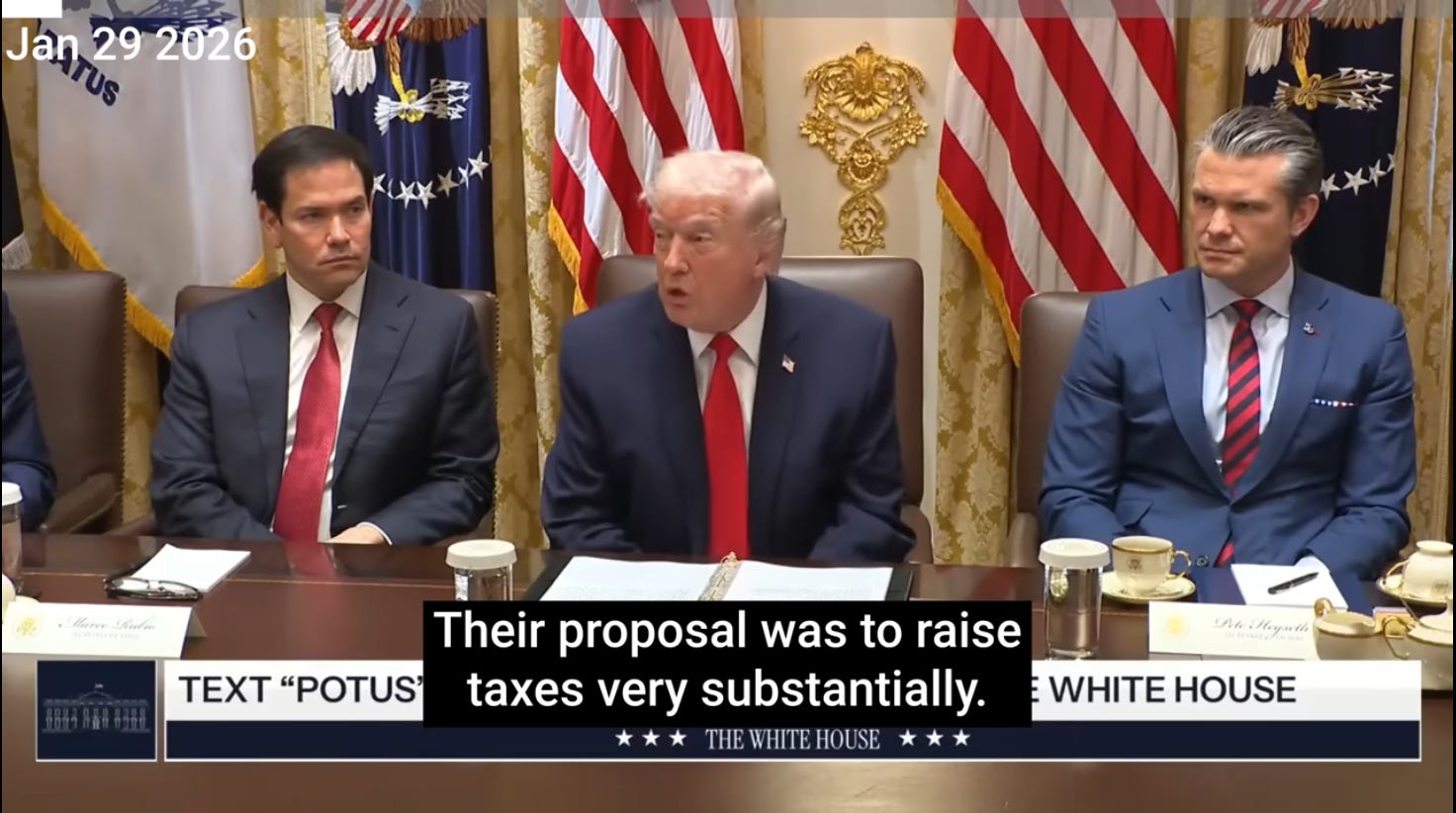
“Their proposal was to raise taxes very substantially and our proposal, which is in the great big beautiful New Deal.
“It’s a new deal in its own way; it’s a Republican version of the New Deal.
“Right behind you is a nice picture of FDR.
“This is a much better deal than the FDR deal.”
Now, Kevin Warsh didn’t just accept the nomination; he declared war on the globalist economic model.
He explicitly said that the Fed must abandon the dogma that paying workers causes inflation.
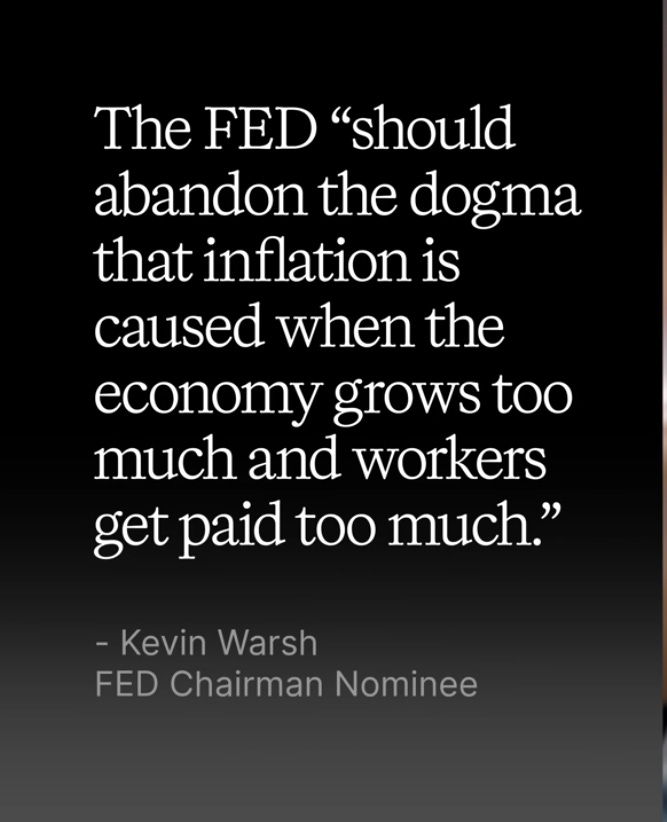
Warsh is calling out the real culprit:
money printing and Wall Street bailouts.
And this follows Ambassador Jameson Greer’s shockwave speech at Davos last week, in which he dusted off Alexander Hamilton to tell the elites: your system is over…

Regime Change at the Fed (01:39)
When you look at much of the mainstream media’s coverage of Warsh, you get a kind of whistling past the graveyard feeling.
Many of the headlines uncharacteristically reported the fact of his appointment with no screaming adjectives, not exactly typical of the New York Times or National Public Radio …


Scratch a little deeper, and the fear starts seeping in.
The Atlanta Council, which is the voice of NATO and the Anglo-American elites (as well as the MSM training grounds), worried that Warsh and Treasury Secretary Besant are in sync in their attacks on how the Fed has saved Wall Street at the expense of Main Street.
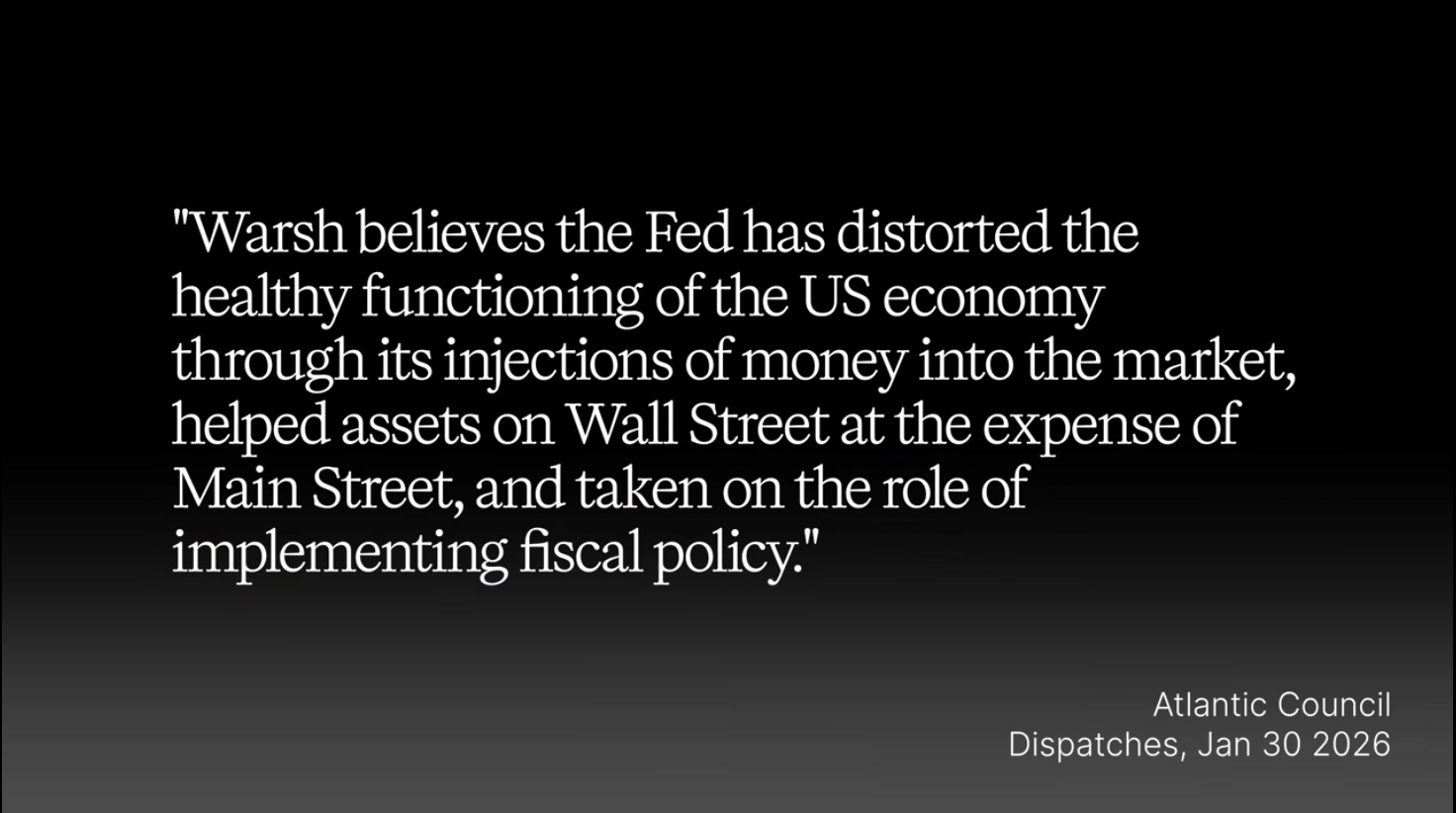
Here’s what the Atlantic Council’s lead international economist said...
Guess who else thinks exactly the same thing?
U.S. Treasury Secretary Scott Bessent.
But it gets even better.
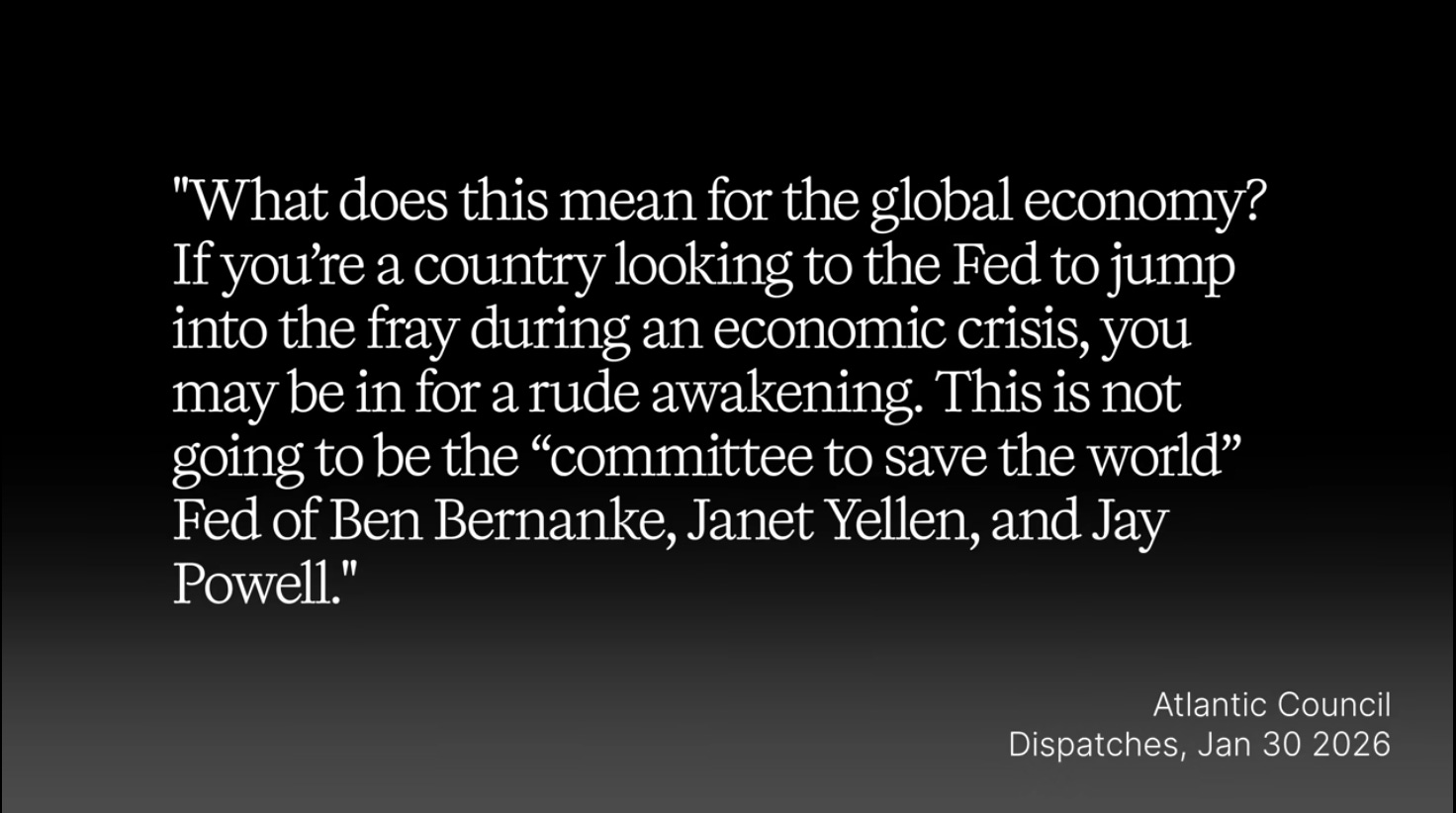
The Atlantic Council author spelled out the consequences of this...
And CNBC, which ran the headline, Kevin Warsh touts regime change at the Fed…

They really did use the word regime change, and so did Kevin Warsh.
Now you’re going to get a counter narrative from some establishment mouthpieces who are either whistling past the graveyard or hoping to control Warsh, like the Council on Foreign Relations, which consoles itself with this analysis…

link / archive (PDF, opens in our online library)
Or the central banker’s central banker, Mark Carney, who’s going to try and play nice by praising Warsh.

But anyone who looks at the Warsh nomination in isolation from everything else this administration is saying or doing is not looking at the bigger picture.
Look at the second part of that CNBC headline, the part about the partnership with the Treasury.
Here’s what they said…
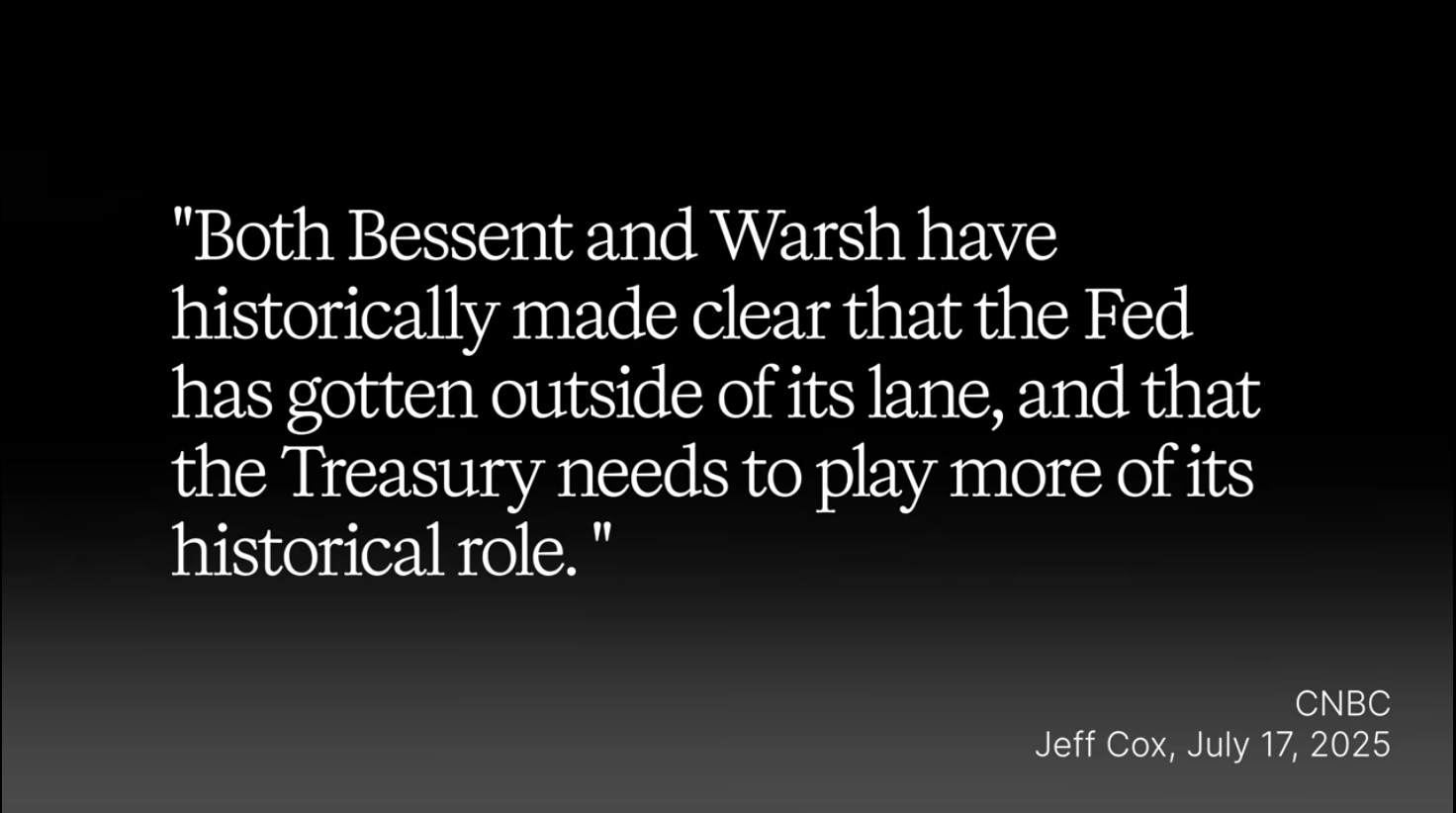
Both Bessent and Warsh have long made clear that the Fed has strayed outside its lane and that the Treasury needs to play a more historical role.
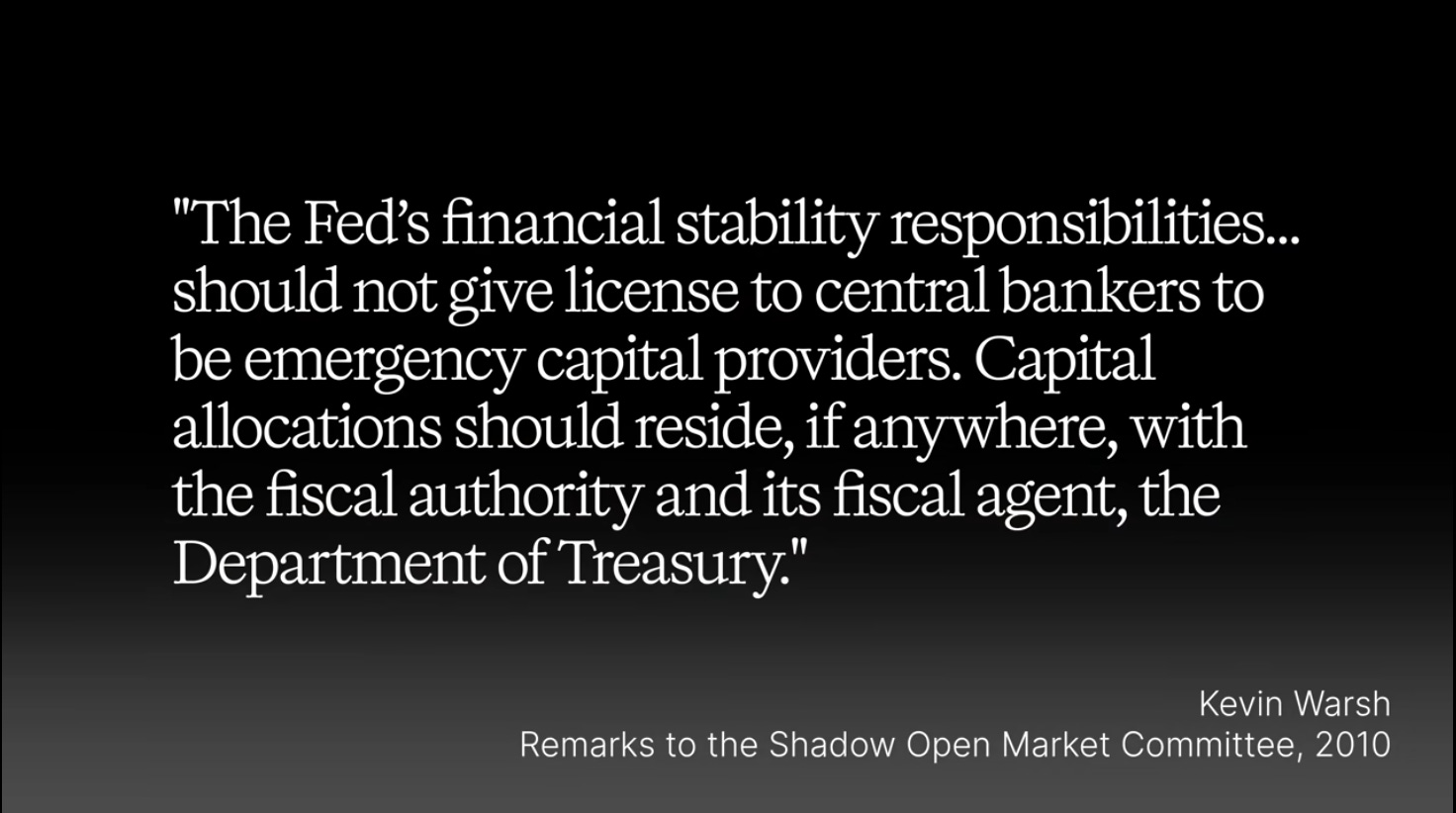
And here’s what Warsh himself said in 2010...
That gets us to the battle that’s been going on for over 200 years - the battle between the American system of Alexander Hamilton and the British Imperial system.
Why They Assassinated the American System (05:00)
The American system was openly put on the table of, at all places, Davos.
Everyone saw the fireworks at Davos - they saw President Trump and Commerce Secretary Lutnik telling the assembled so-called elites that globalism had failed and their very reason for being was over.
You saw Scott Bessent’s multiple and masterful takedowns of Gavin Newsom, but the real killer shot was delivered by special trade ambassador Jamison Greer in his speech titled "The Hamiltonian Economic System1," which too many have forgotten.
Here’s how he began....
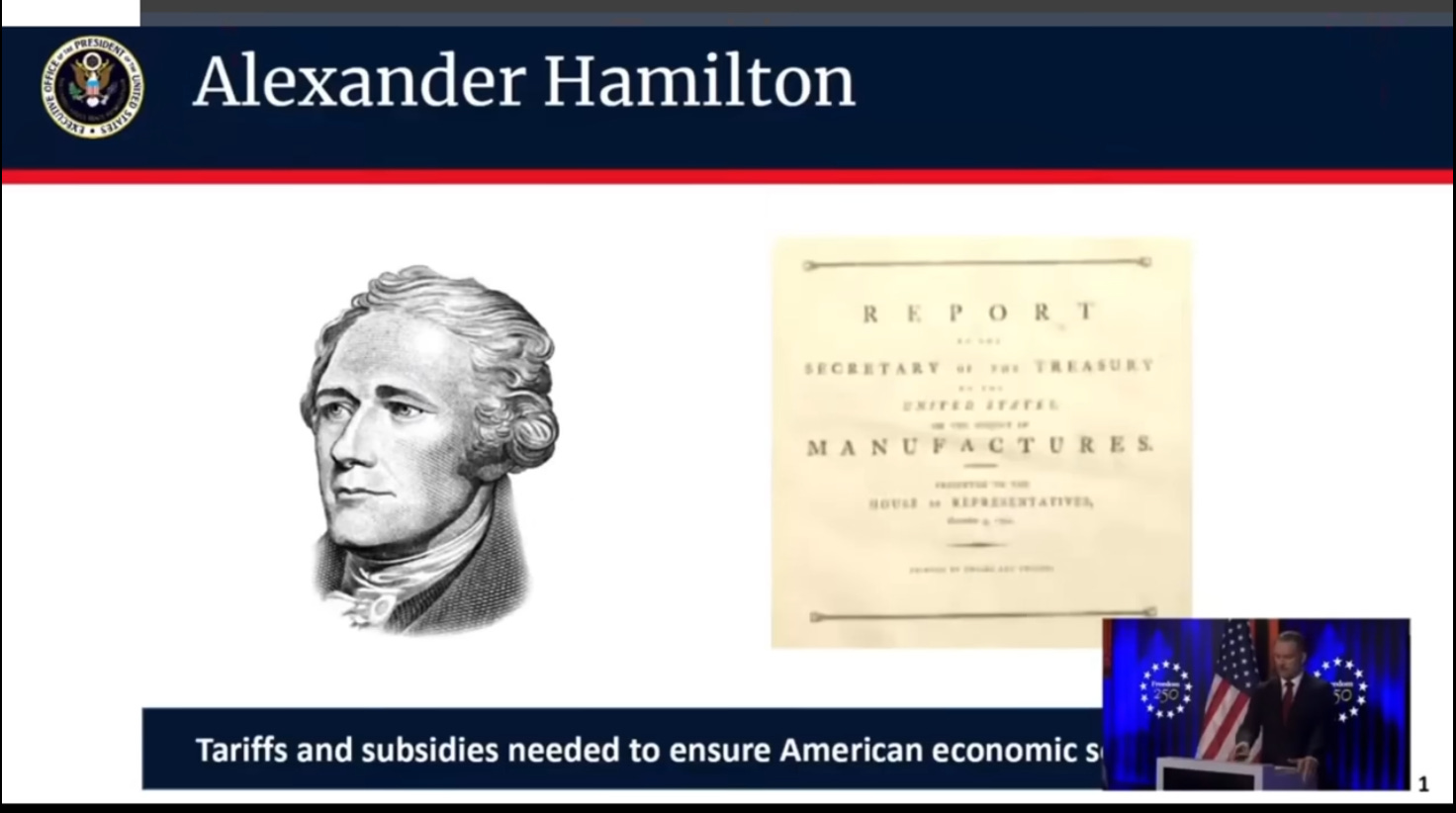
On December 5th, 1791, America’s first Treasury Secretary, Alexander Hamilton, delivered something called the Report on Manufactures to Congress.
In that report, Hamilton articulated a plan for the United States to shake off its economic dependency on the British Empire.
In that report, Hamilton argued for a strong economic policy that would allow America to become an industrial power.
He called for a combination of tariffs and subsidies to incentivize industrialization.
Hamilton believed that such measures were necessary to promote the development of industries, like textiles at the time, that needed protection from dominant foreign producers to develop the scale that would allow them to supply US needs and also be globally competitive.
This vision, as I will discuss, laid the foundation for American and even global prosperity in the 19th and 20th centuries.
Jamison Greer’s Full Speech and Q&A Session at Davos
Now look at that title again.
The Hamiltonian economic system that too many have forgotten.
Well, it wasn’t just forgotten.
Here’s what they don’t tell you in the history books.
Every American leader who seriously pursued Hamiltonian economics got assassinated, starting with Alexander Hamilton, who was shot in 1804 by Aaron Burr.
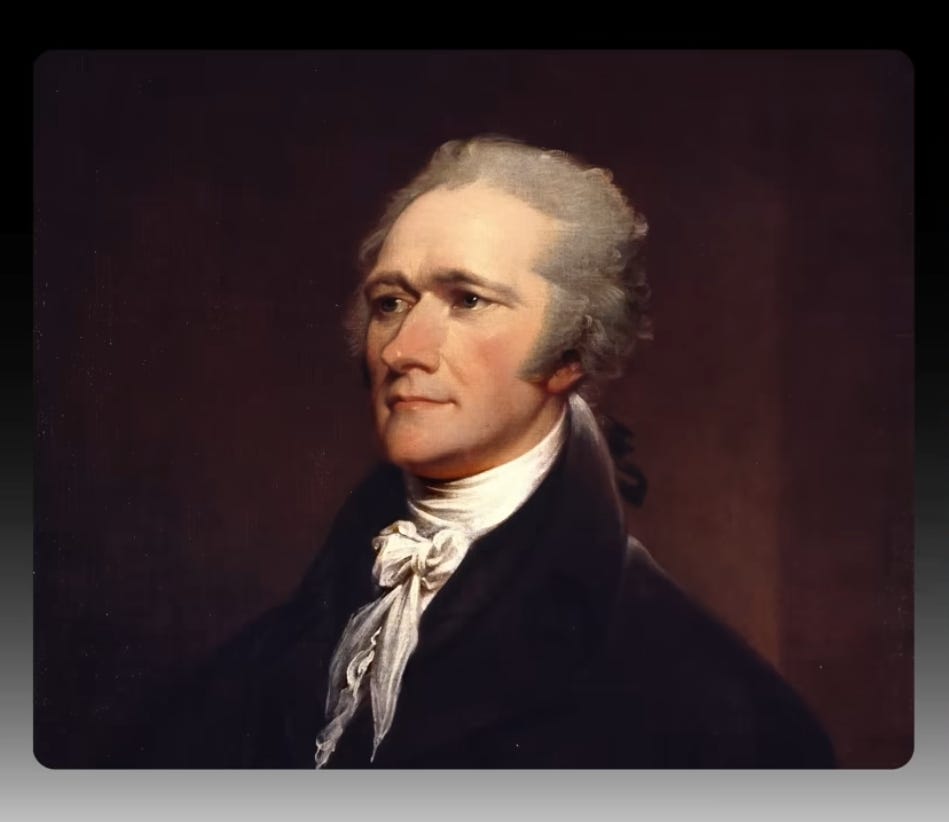
Hamilton’s genius had made us economically sovereign, with a national bank that ensured our independence from the Bank of England and a tariff system that protected our manufacturing and workers.
Abraham Lincoln, well, he was shot in 1865.
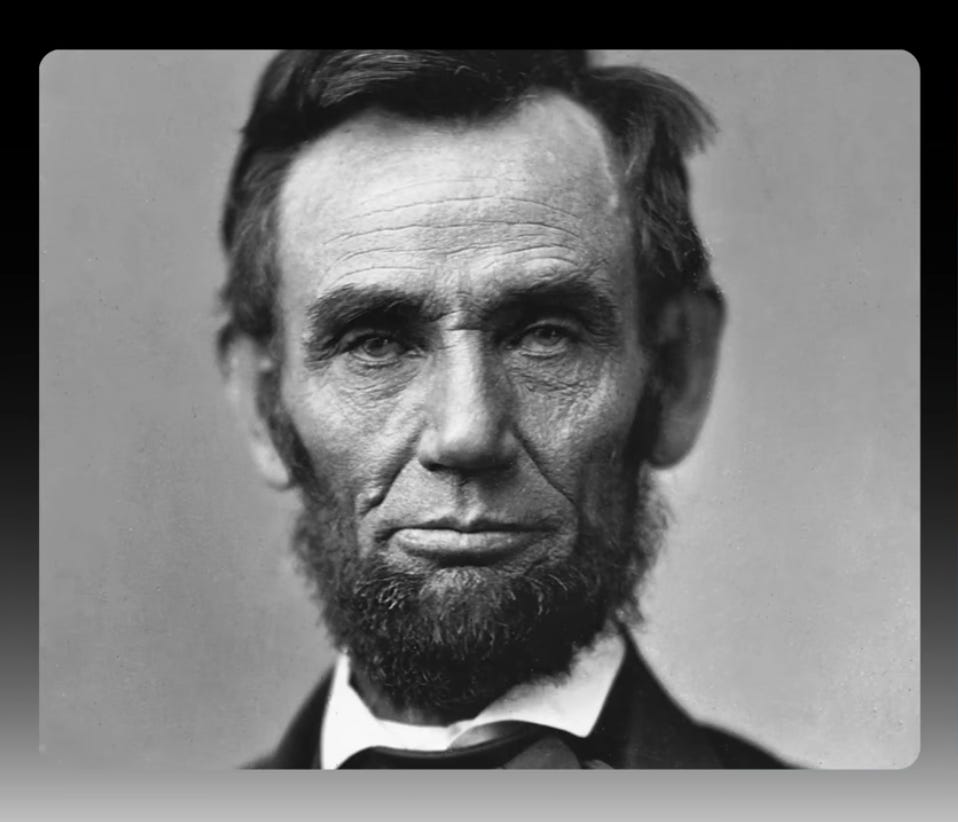
Why?
For pursuing the same policies of national banking, tariffs, and internal improvements.
And then, in 1901, William McKinley.
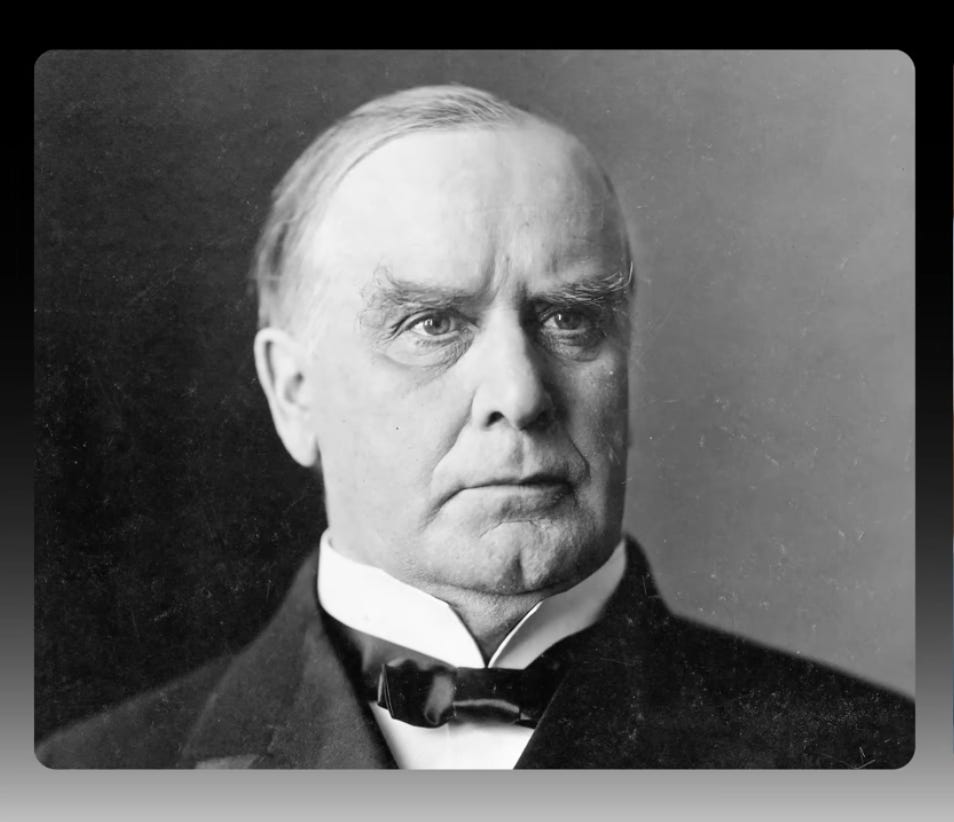
Now McKinley has become more in the public eye recently because President Trump is constantly pointing out that McKinley’s tariffs made us wealthy and industrially strong, and he was assassinated, too.
If you wanna know more about the history of how it is that it’s the British who assassinate our presidents, check out Promethean Action’s ebook, It Is the British Who Murder Our Presidents, on their website.
Now, what happened 12 years after McKinley was assassinated?
The United States fell under the British-run central banking system with the establishment of the Federal Reserve.
Now think again about the appointment of Kevin Warsh and his alignment with Scott Bessent on tilting the balance away from the Fed to the Treasury for the benefit of Main Street.
So when the Democrats or even some of the lunkheaded Republicans try to turn the Warsh nomination into an academic debate of interest rates, remember that history and realize that something very, very big is happening.
So what does very big actually look like?
You’re not going to hear about it in the political chatter or in market commentary.
You’ll see it on the ground in factories and in paychecks.
The Receipts: $18 Trillion on Main Street (08:20)
President Trump emphasized the same point that Warsh made about the Fed throttling growth in Thursday’s cabinet meeting when he said this…
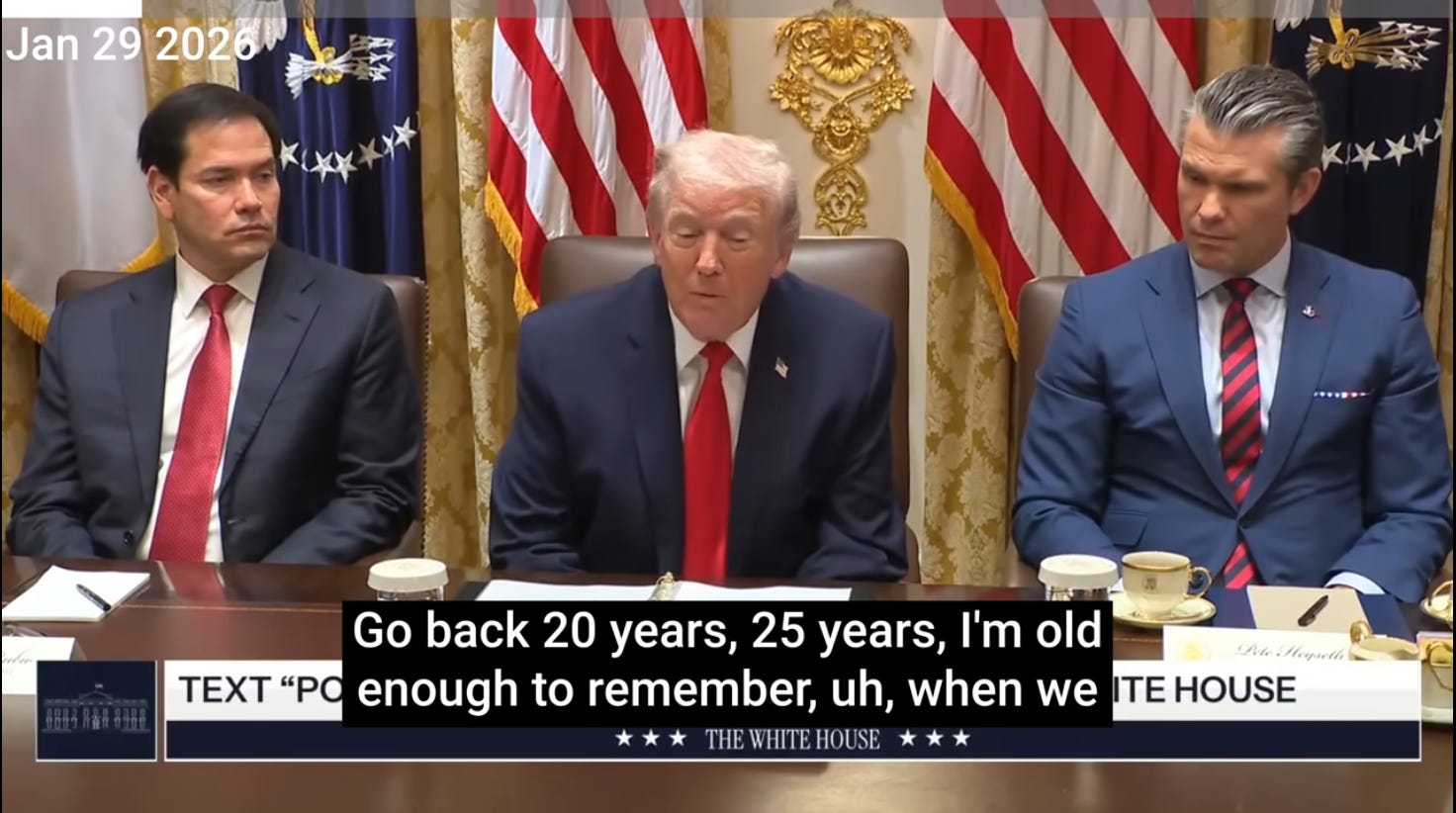
“Go back 20 years, 25 years... I’m old enough to remember.
“When we had good news, and when you announced it, the stock market went up.
“You announce anything good, the stock market went up.
“You announce bad, the stock market went up.
“And that’s the way it should be.
“But now it’s, over the last 15 or so years, if you announce good news, that means they’re going to raise interest rates because they want to kill it.
“It can never really be that successful because you announce all record numbers great great great because they’re afraid of inflation but growth doesn’t have to have any impact on inflation it can make inflation go down in many cases.”
And that is how it works: the Fed has been deliberately strangling American growth to protect Wall Street and its international brethren in London and elsewhere.
This is the British model of economics: sacrifice everything, industrial growth, wages, productivity, to feed a financial cancer.
What has passed for economic discussion has always been about money or financial flows.
But Trump’s cabinet meeting wasn’t about that - it was about workers, it was about production, and Main Street.
Trump did call it a Republican version of the New Deal.
But here’s what that actually looks like on the ground, not in financial markets, but in factories and in the lives of working families.
They talked about the $18 trillion being invested right now, with thousands of businesses, plants, and equipment all over the country springing up.
To the applause of the entire cabinet, Treasury Secretary Bessent announced that, for the first time in 26 years, the United States had produced more steel than Japan.
And he said to the president that it is entirely driven by your tariffs.
They also reported that John Deere announced two new massive plants being built in Indiana and North Carolina.
The North Carolina plant will build excavating equipment.
There hasn’t been an excavator built in this country in 50 years.
And this plant is relocating from Japan back to the United States because of President Trump’s tariffs.
Here’s a map which shows just a few of the other factory restarts where we are gearing up a productive capacity here at home that we haven’t had in decades…
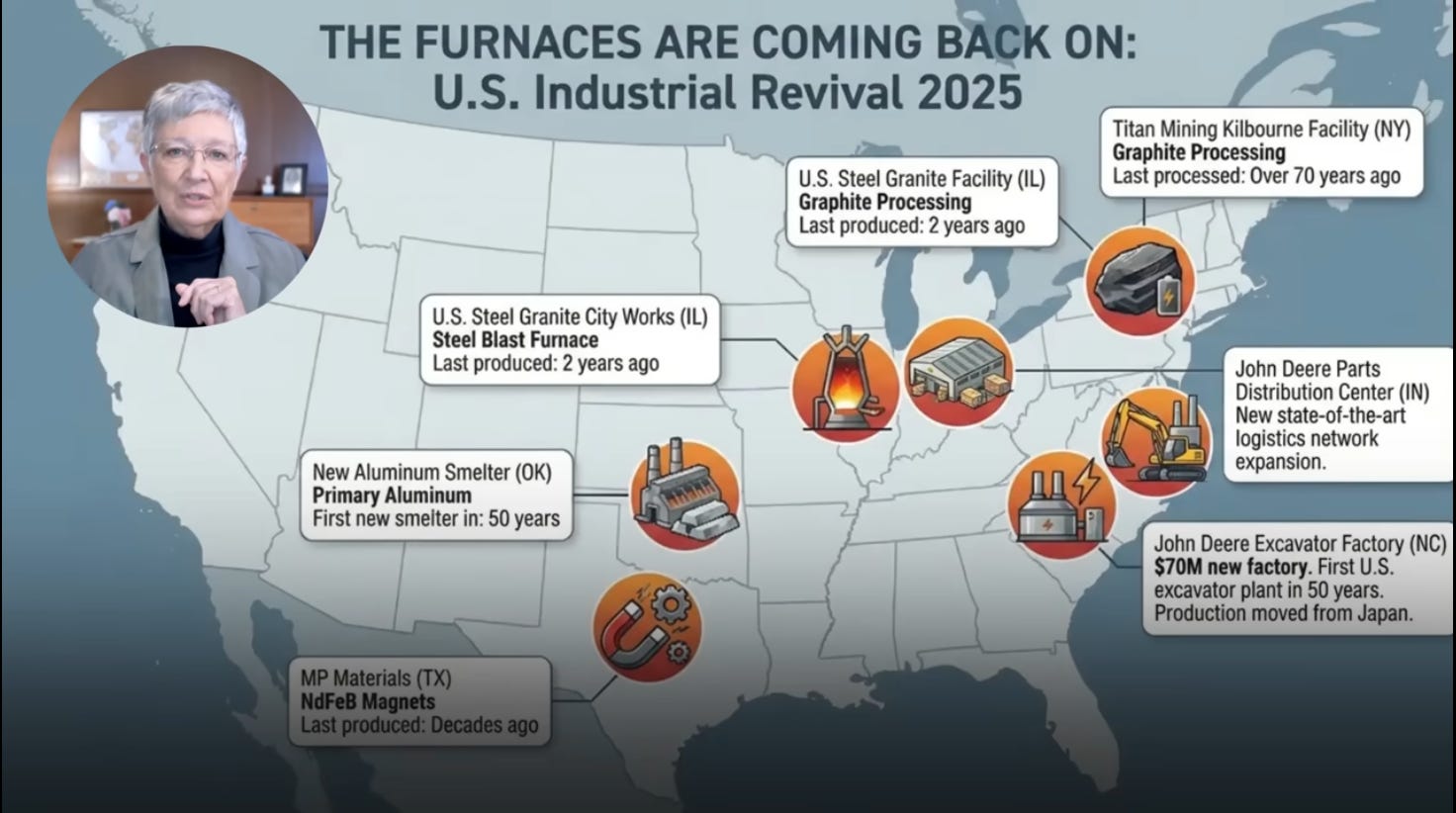
Like a graphite processing plant in New York, the first one in the U.S. in 70 years.
Commerce Secretary Howard Lutnick told the president, you’ve changed America and created the golden age.
It is a golden age out of a dark age of economic destruction.
But if you are listening to the mainstream press, or if you’re caught up in today’s mega world social media storm, whatever it is, you’re going to miss this.
Small Business Administrator Head Kelly Loeffler said just that…
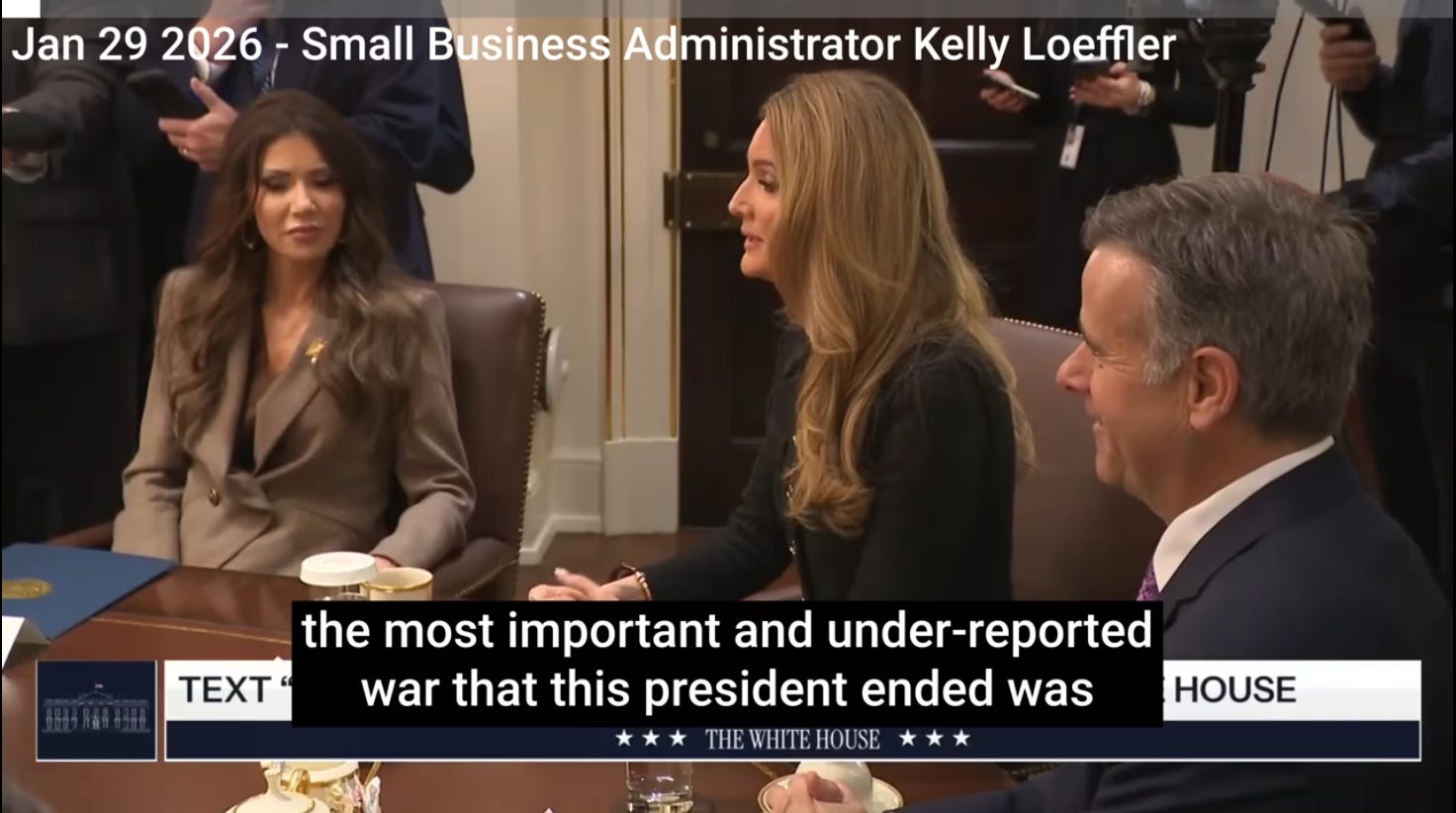
“... the most important and under-reported war that this president ended was Joe Biden and the Democrats’ war on Main Street and hard-working families.
“We’ve seen it as I’ve gone across the country this month, 10 different states, and we saw it when we were together in Iowa, hardworking families, farmers, small businesses expressing gratitude lined up to thank you.
“I was out with our great Vice President last week in Toledo, Ohio.
“They are thanking this administration for getting Main Street back.
“The Trump tax cuts, the tariffs, deregulation, it’s all rocket fuel for hardworking families and Main Streets.”
Remember This? Not Aging Well At All, Thank God and No Thanks to the Democrats…
More Of What You Don’t See But Will Gain Benefits
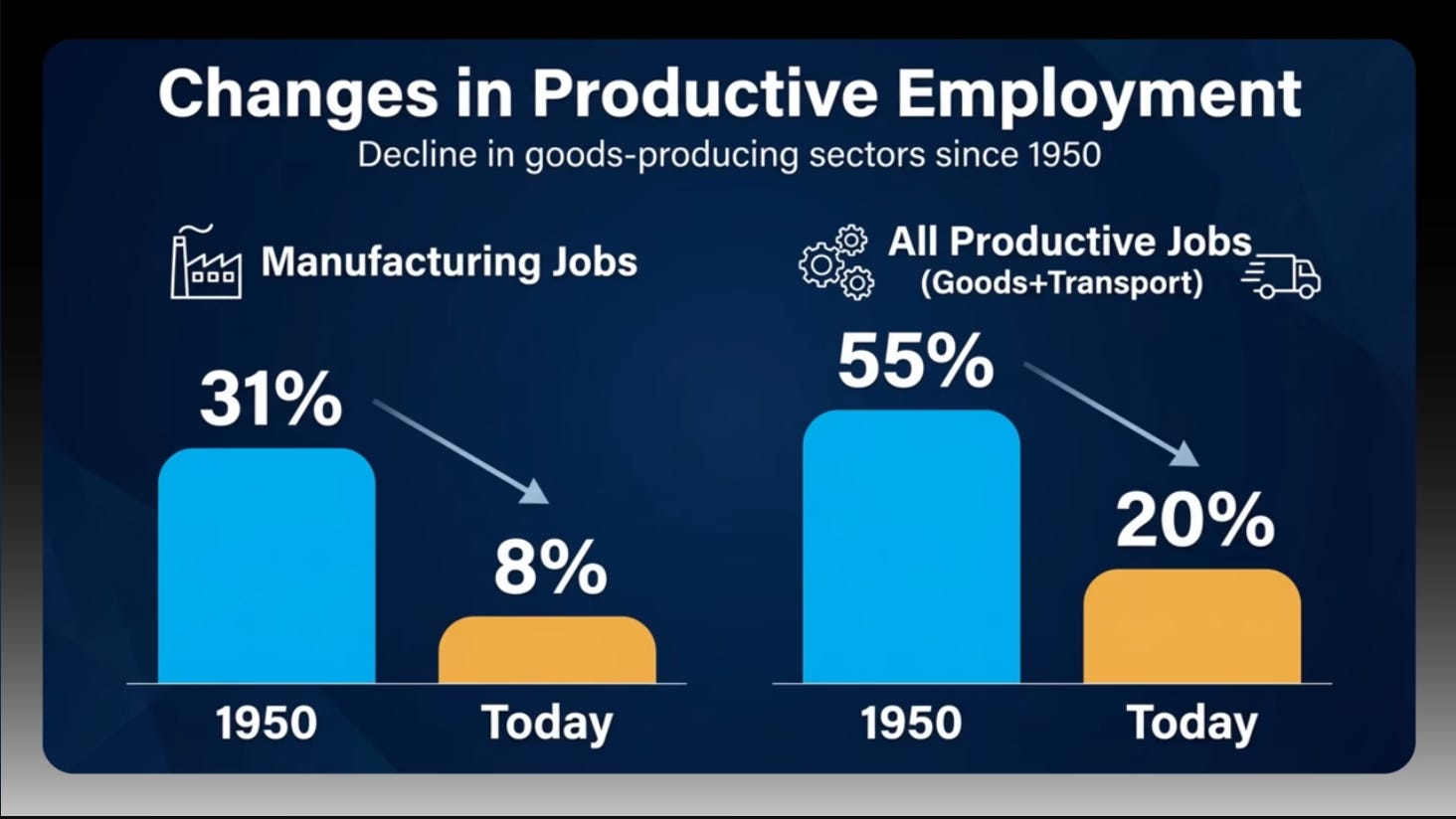
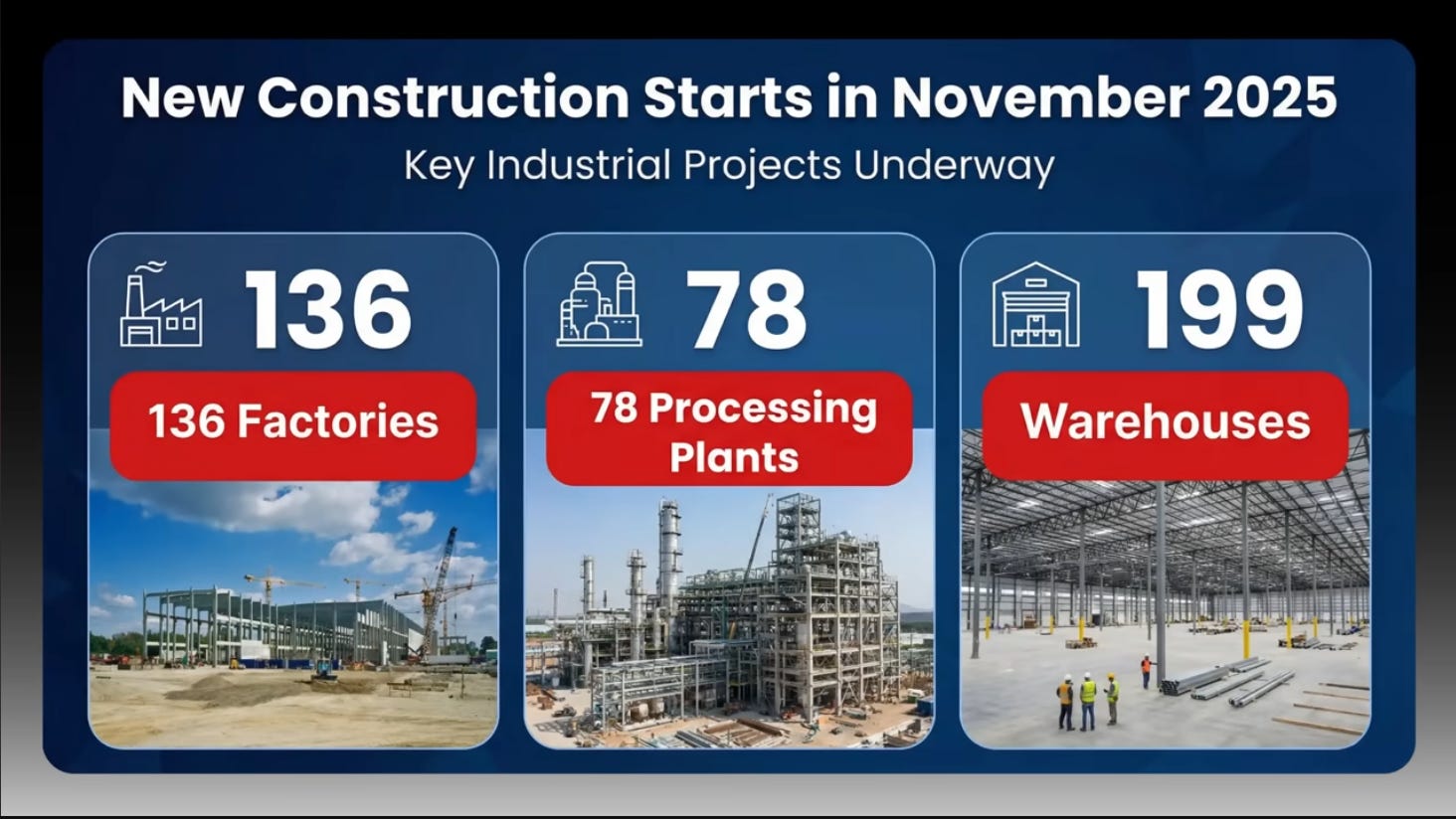
All this turnaround, not only in the economy but in the hope of the people for true freedom, is what the empire hates: a nation with economic sovereignty, a robust middle and working class with rising wages and hope for the future.
And that’s what Donald Trump is delivering.
He isn’t asking the City of London or the Federal Reserve for permission anymore.
His 20 trillion in foreign investments channel money directly into the economy outside the Fed's control.
So manufacturing is back, small businesses are reviving, wages are rising, and energy is flowing.
And now he’s put his man in at the Fed so the Fed can’t get in the way.
That’s the Republican New Deal.
Not bailouts for banks, but production for workers.
The American system is coming back.
In Summary
Kevin Warsh isn’t just a Fed nominee; he’s a declaration of war on the Wall Street bailout machine and a direct challenge to decades of British-style central banking independence.
Jameson Greer’s Hamilton speech at Davos is the resurrection of the American system.
And Donald Trump’s Republican New Deal isn’t a slogan, it’s here.
But like SBA Administrator Loeffler said, you’re not hearing this.
And if you’re not hearing it, you can’t organize with it, which is why you need to search out organizations such as Decisive Liberty News and Promethean Action so that you can hear it and organize with it.
The modern British Empire is panicking because the fight is out in the open.
Commerce Secretary Lutnik said it at Davos: globalization is over.
Fed nominee Warsh said it, Main Street, not Wall Street.
And the cabinet meeting celebrated it.
The enemy knows that if Trump succeeds and the American system comes back to life, their century of control is over, just in time for our 250th birthday.
FOOTNOTES
Alexander Hamilton’s Economic Principles
Alexander Hamilton, as the first Secretary of the Treasury, developed a comprehensive economic program designed to establish a strong financial foundation for the United States.
His vision included the
establishment of a national bank
federal assumption of state debts incurred during the Revolutionary War
implementation of tariffs to protect nascent American industries
Hamilton’s economic principles were articulated in key documents, most notably his 1791 Report on Manufactures.
This report emphasized the importance of industrialization and manufacturing for national security and economic independence, challenging the prevailing view that the U.S. should remain primarily an agrarian economy.
Central to Hamilton’s plan was the belief that a robust national government and a strong financial system were essential for both national security and sustained economic growth.
He also advocated concrete views on trade, banking, and venture financing, which contributed significantly to America’s industrial policy and rapid industrialization.
Perspectives
Hamilton’s Nationalist, Pro-Industry, and Strong Government Approach
Hamilton advocated for a “great American system” of economy, emphasizing a strict and indissoluble union of states to strengthen the economy and ensure national economic independence.
He believed that self-interest was a powerful incentive for human actions, driving individuals to accumulate property, which in turn created commerce and industry, with government playing a role in protecting private property.
Hamilton’s logic was forged from his experiences during the Revolutionary War, where he saw the necessity of self-reliance in manufacturing to achieve true freedom and liberty, particularly for procuring materials to fight a war.
His policies included tariffs to protect young American industries from foreign domination, especially from Britain, and to generate revenue for the federal government.
Critiques and Alternative Views (Implicitly Jeffersonian)
Hamilton’s economic program faced significant opposition from figures like Thomas Jefferson, who favored an agrarian society and states’ rights over national power.
Adam Smith’s The Wealth of Nations (opens in our online library), which Hamilton leaned on for his report, emphasized laissez-faire economics, free trade, and the ‘invisible hand’ of the economy, principles against which Hamilton’s state interventionist ideas revolted.
Critics of Hamilton’s program viewed the perquisites of the states as more essential than enhancing national power and preferred a predominantly agrarian society to a balanced economy.
Modern economic theories, such as neoclassical, Austrian, and MMT, assume a stable supply chain and have been developed by dominant players, contrasting with Hamiltonian logic, which emphasizes self-reliance in manufacturing forged during times of contention