

President Trump re-established the 1776 Advisory Committee to restore true American history.

This post reveals a lost 400-page manuscript proving that America’s founders drew their ideas from Leibniz, not Locke, and fought for intellectual independence decades before 1776.
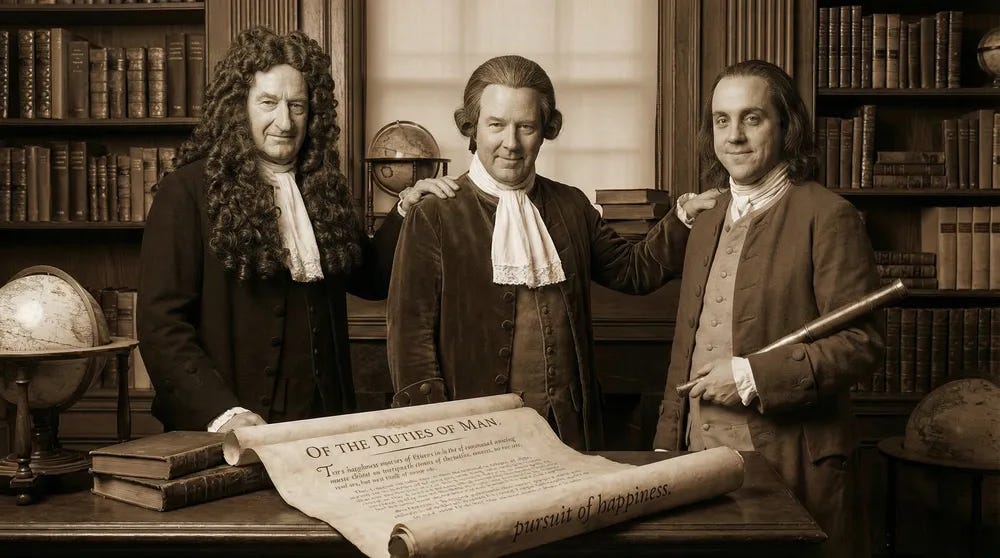
Introduction
Today’s culture is permeated by a bestial concept of Man.
Hollywood’s movies glorify the right of the individual to exact revenge against those power-hungry individuals who have wronged their heroes.
Even music glorifies the “victims” of society, raging against their oppressors.
This is Thomas Hobbes’ view of society as a “dog-eat-dog” world.
According to Hobbes, man is only capable of acting in his own self-interest.
Therefore, an authoritarian government is the only way to restore order, through a “social contract” to stop civilization from complete destruction.
This was the justification for the newly forming British Empire in the 1680s and is the same justification for the elites’ globalist “One World Order” today.
We’re Not Animals
But the success of our own American Revolution was due to a core group of founders who embraced the Renaissance’s distinction between humans and beasts.
They were committed to the concept of Man as Imago Viva Dei; that every human being was made in the image of the Creator and possessed a unique creative mind capable of discovering new principles in the Universe and transmitting them to future generations to secure the progress of humanity and the higher organization of the Universe itself.
Continuous discoveries of new principles allowed humans to develop whole new philosophical concepts of the unseen laws of the Universe.
These concepts translated into technological and cultural transformations of society as a whole.
As we shall see, our founding documents were based on the higher philosophical concept of Life, Liberty, and the Pursuit of Happiness, drawn from Gottfried Leibniz, rather than the idea of Life, Liberty, and Property, drawn from John Locke.
These two irreconcilable concepts of Man, the Hobbesian view of Man as an unreasoning Beast vs. the Leibnizian view of Man as Imago Viva Dei, have defined the fight for our Republic from its inception to the present.
You Probably Learned False History
Although the British Empire’s apologists, such as Thomas Hobbes, John Locke, and Isaac Newton, were thoroughly rejected by the intellectual giants who formed our nation, our own history has been rewritten to ascribe their philosophies to the founders.
Not only that, their subversive ideas shape the thinking of a majority of society today.
The high-level philosophical, scientific, and cultural warfare between these two concepts of man, which ultimately brought into being this first successful Republic, has almost been obliterated from the common knowledge of our citizens today.
To defeat the current threat to our nation and humanity, waged by the heirs of that British Oligarchical/Globalist system today, we must restore that knowledge to the patriots of our country now.
James Logan
James Logan is one of the most critical figures in American history.
Between 1735 and 1737, Logan penned one of the most important philosophical documents in our pre-revolutionary history, entitled “Of the Duties of Man as they may be deduced from Nature.”
This book is a thorough, well-reasoned refutation of the theories of Hobbes, John Locke, and Isaac Newton.
It demonstrates that an “intellectual independence” from the British Empire, steeped in the ideas of the Renaissance-rooted philosopher Gottfried Leibniz, existed in a developing American intelligentsia decades before the formal Declaration of Independence.
Logan’s 400-page manuscript was considered lost for more than 200 years until a copy was discovered in the early 1970s among cartons stored at the Historical Society of Pennsylvania.
See, The Anti-Newtonian Roots of the American Revolution.
Even after its publication in book form in 2013 by Phil Valenti, an associate of Lyndon LaRouche at the time, it has been relegated back to near oblivion once again.
The only place where it is publicly available is at Philadelphia’s Mosey Library. 1
What follows are essential quotes from that manuscript and Valenti’s groundbreaking work.
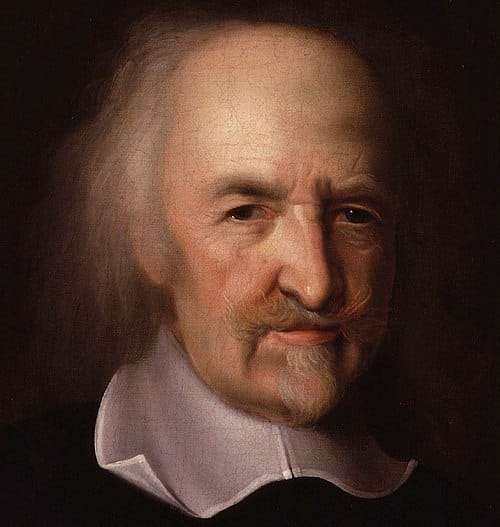
James Logan, Philip Valenti Print Book, English, ©2013 Publisher: Philip Valenti, Philadelphia, Pa., ©2013. Mossey Library Available, Main Book Collection - 2nd floor; BJ1005.L6 O4 2013