
Relive the Revolutionary War’s defining moments as they unfold in vivid detail - from the first shots fired at Lexington and Concord igniting the fight for freedom, to the grueling endurance of Valley Forge’s frozen winter, and the triumphant siege at Yorktown that forged a new nation.
Witness the courage, sacrifice, and unyielding spirit that propelled these pivotal events to victory.
A couple of details not shared in this short video…
1st Detail: Colonel Rall, the Hessian commander, assumed there would be no attack of any consequence on Christmas night due to a storm and heavy snowfall, despite experiencing numerous skirmishes and false alarms in the days approaching Christmas.
There are, however, some accounts of a scuttle that carried on outside their cabins on Christmas Night, forcing them to scurry out into the snowstorm - only to find no one.
The Hussian became even more relaxed, sensing that whoever it was believed best to leave well enough alone.
2nd Detail: Something that Woodrow Wilson tried to wipe from our history books due to his bias against blacks - look at the painting of the boat with George Washington and his soldiers, 3rd person from the front.
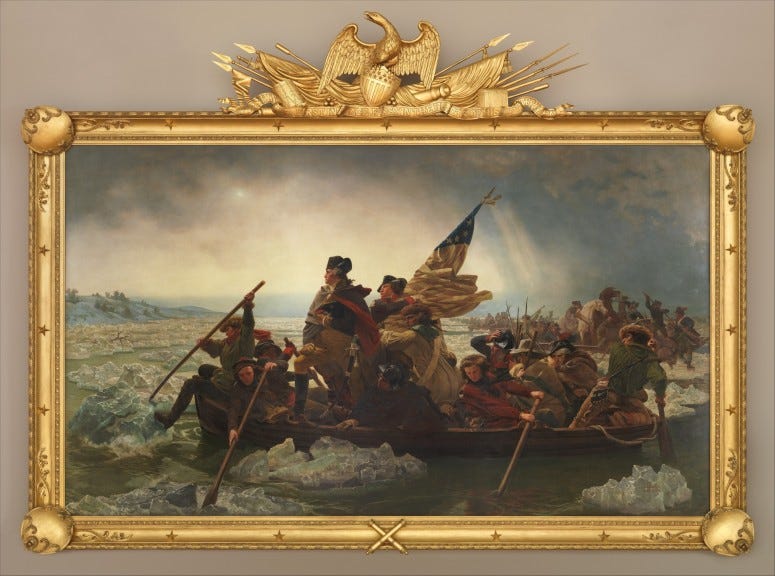
That is not a tan, nor is he being painted as someone not having light fall upon him - this black man’s name is Prince Whipple.
Prince Whipple was an African American man who General William Whipple, a signer of the Declaration of Independence, enslaved.
He was brought to America from Africa, specifically from a region that is now part of Ghana, at a young age, possibly around ten years old.
Prince Whipple later served as a bodyguard to General William Whipple during the American Revolution and was one of 20 enslaved men who petitioned the New Hampshire legislature for freedom in 1779.
Prince Whipple was eventually manumitted by William Whipple, with one source stating this occurred in 1784, and another indicating it was on his wedding day, February 22, 1781.
He married Dinah Chase, and they had seven children, all born into freedom.
Although his petition to abolish slavery in New Hampshire was tabled, Prince Whipple is recognized as an American patriot.
Prince Whipple is long identified as the young African American soldier seated in front of Washington in Emanuel Leutze’s 1851 painting “Washington Crossing the Delaware.”
African American abolitionist William C. Nell first related the story of Prince Whipple’s presence at Trenton in his 1855 volume, “Colored Patriots of the American Revolution,” and this account has remained a primary source.