
Supreme Court strikes down tariffs
via SCOTUSblog
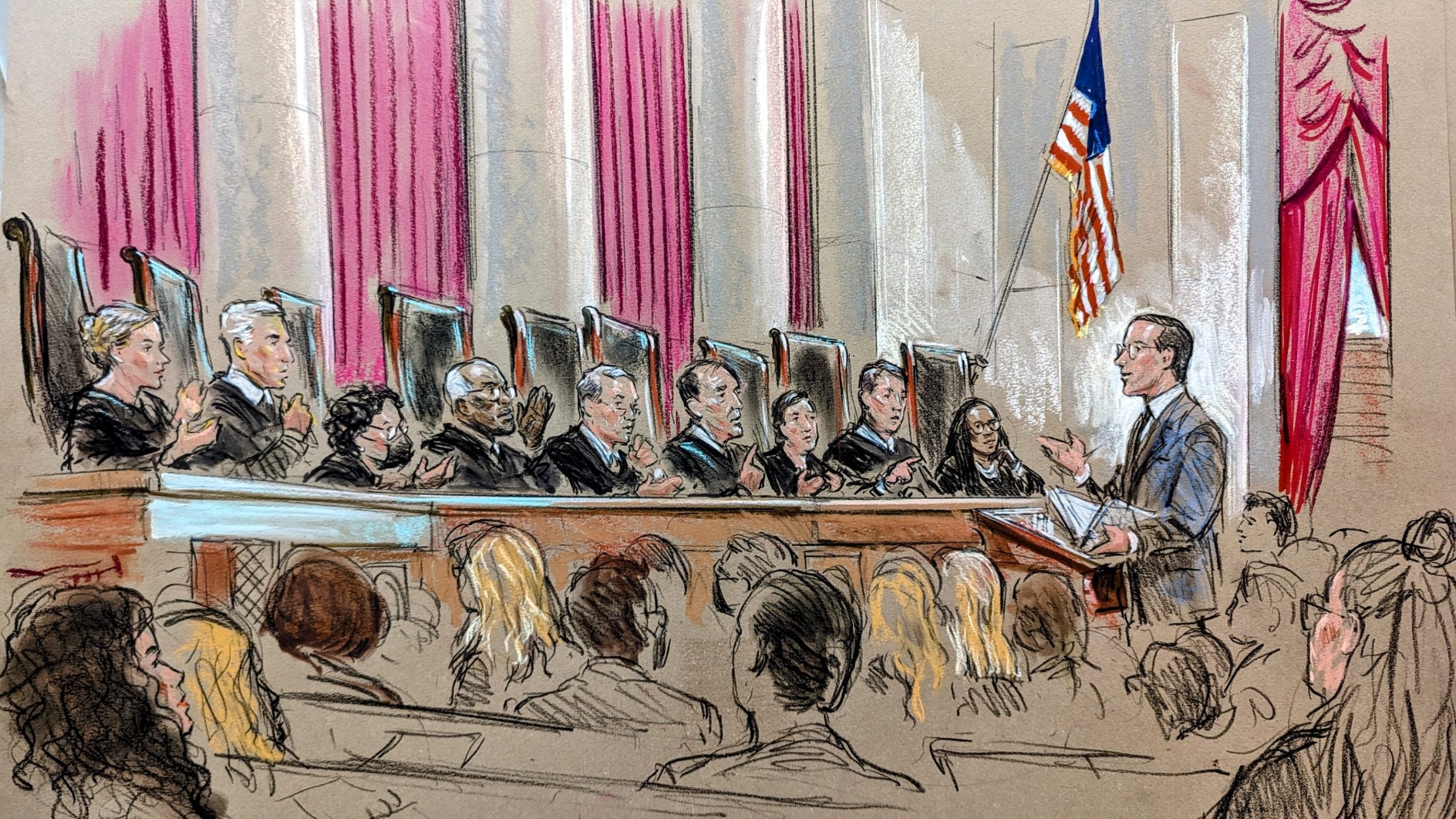
In a major ruling on presidential power, the Supreme Court on Friday struck down the sweeping tariffs imposed by President Donald Trump through a series of executive orders.
By a vote of 6-3, the justices ruled that the tariffs exceeded the powers given to the president by Congress under a 1977 law that authorized him to regulate commerce during national emergencies caused by foreign threats.
The court did not weigh in, however, on whether or how the federal government should provide refunds to the importers who have paid the tariffs, estimated in 2025 at more than $200 billion.
In his dissenting opinion, Justice Brett Kavanaugh suggested that the federal government …
“may be required to refund billions of dollars to importers who paid the IEEPA tariffs, even though some importers may have already passed on costs to consumers or others.”
Moreover, he added, “[b]ecause IEEPA tariffs have helped facilitate trade deals worth trillions of dollars—including with foreign nations from China to the United Kingdom to Japan, the Court’s decision could generate uncertainty regarding various trade agreements. That process, too, could be difficult,” Kavanaugh warned.
The law at the center of the case is the International Emergency Economic Powers Act, known as IEEPA, which authorizes the president to use the law
“to deal with any unusual and extraordinary threat, which has its source in whole or substantial part outside the United States, to the national security, foreign policy, or economy of the United States, if the president declares a national emergency with respect to such threat.”
A separate provision of the law provides that when there is a national emergency, the president may “regulate … importation or exportation” of “property in which any foreign country or a national thereof has any interest.”
The dispute that led to Friday’s opinion began last year, when Trump issued a series of executive orders imposing the tariffs.
One set of tariffs, known as the “trafficking tariffs,” targeted products from China, Canada, and Mexico – which, Trump says, have not done enough to stop the flow of fentanyl into the United States.
Another set, known as the “reciprocal” tariffs, imposed an initial 10% tariff on imports from almost all countries and even higher tariffs on products from dozens of countries.
In imposing those tariffs, Trump cited large trade deficits as an …
“unusual and extraordinary threat to the national security and economy of the United States.”
Lawsuits filed by small businesses and a group of states, all of which say that they are affected by the increased tariffs, were filed in the lower courts, which agreed with the challengers that IEEPA did not authorize Trump’s tariffs.
But those rulings were put on hold, allowing the government to continue to collect the tariffs while the Supreme Court proceedings moved forward.
In a splintered decision on Friday, the Supreme Court agreed with the challengers that IEEPA did not give Trump the power to impose the tariffs.
“Based on two words separated by 16 others in … IEEPA—‘regulate’ and ‘importation’—the President asserts the independent power to impose tariffs on imports from any country, of any product, at any rate, for any amount of time,” Chief Justice John Roberts wrote.
“Those words,” he continued, “cannot bear such weight.
“IEEPA,” Roberts added, “contains no reference to tariffs or duties.”
Moreover, “until now no President has read IEEPA to confer such power.”
In a part of the opinion joined by Justice Neil Gorsuch and Justice Amy Coney Barrett, Roberts said that Trump’s reliance on IEEPA to impose the tariffs violated the “major questions” doctrine – the idea that if Congress wants to delegate the power to make decisions of vast economic or political significance, it must do so clearly.
In 2023, the court relied on the “major questions” doctrine to strike down the Biden administration’s student-loan forgiveness program. In that case and others like it, Roberts observed, it might have been possible to read the federal law at issue to give the executive branch the power it claimed.
But “context” – such as the constitutional division of power among the three branches of government – and “common sense” “suggested Congress would not have delegated ‘highly consequential power’ through ambiguous language.”
In cases like this one, Roberts continued, in which the Trump administration contends that Congress has delegated to it “the core congressional power of the purse,” considerations like context and common sense “apply with particular force.”
“[I]f Congress were to relinquish that weapon to another branch, a ‘reasonable interpreter’ would expect it to do so ‘clearly.’”
And indeed, Roberts said,
“[w]hen Congress has delegated its tariff powers, it has done so in explicit terms, and subject to strict limits,” …
A test that Trump’s tariffs failed here.
The tariff question is indeed one of “economic and political significance,” Roberts added, which also suggests caution before interpreting IEEPA to grant the power that the president seeks.
Quoting the Trump administration’s brief in the Supreme Court, Roberts noted that,
“[i]n the President’s view, whether ‘we are a rich nation’ or a ‘poor’ one hangs in the balance. These stakes dwarf those of other major questions cases.”
Nor, contrary to the Trump administration’s argument, does the fact that IEEPA involves an emergency power or foreign affairs preclude the justices from applying the major questions doctrine, Roberts said.
The Supreme Court rejected a similar argument about emergency powers in the student-loan forgiveness case, Roberts emphasized.
In fact, he suggested, courts should be skeptical of reliance on alleged emergencies to infringe on powers reserved for Congress.
And Congress, rather than the president, has the power to impose tariffs during peacetime, Roberts wrote.
The court’s three Democratic appointees – Justices Sonia Sotomayor, Elena Kagan, and Ketanji Brown Jackson – joined another part of the Roberts opinion, holding that Trump’s tariffs were also not supported by the text of IEEPA.
As an initial matter, Roberts wrote that “IEEPA authorizes the President to ‘investigate, block during the pendency of an investigation, regulate, direct and compel, nullify, prevent or prohibit . . . importation or exportation.’”
That list, Roberts stressed, does not include tariffs or duties at all – an absence that …
“is notable in light of the significant but specific powers Congress did go to the trouble of naming. It stands to reason,” Roberts said, “that had Congress intended to convey the distinct and extraordinary power to impose tariffs, it would have done so expressly—as it consistently has in other tariff statutes.”
IEEPA’s use of the words “regulate” and “importation” are not enough to give Trump the power to impose tariffs, Roberts concluded.
“The U.S. Code,” Roberts noted, “is replete with statutes granting the Executive the authority to ‘regulate’ someone or something. Yet the Government cannot identify any statute in which the power to regulate includes the power to tax.”
Indeed, Roberts added, interpreting the word “regulate” in IEEPA to include the power to tax “would render IEEPA partly unconstitutional,” because it gives the president the power to regulate importation or exportation, but the Constitution specifically bars taxes on exports.
Roberts observed that Trump’s interpretation of IEEPA would
“give the President power to unilaterally impose unbounded tariffs,” “unconstrained by the significant procedural limitations in other tariff statutes and free to issue a dizzying array of modifications at will” …
as long as he declares an emergency – a determination that, Roberts added, courts would not be able to review.
Such an interpretation, Roberts said, “‘would represent[] a “transformative expansion”’ of the President’s authority over tariff policy and indeed … over the broader economy as well.”
Finally, Roberts concluded by emphasizing that “[w]e claim no special competence in matters of economics or foreign affairs. We claim only, as we must, the limited role assigned to us by Article III of the Constitution. Fulfilling that role, we hold that IEEPA does not authorize the President to impose tariffs.”
In his 63-page dissent, Kavanaugh acknowledged that “[t]he tariffs have generated vigorous policy debates.”
But such debates, he said, “are not for the Federal Judiciary to resolve.
Rather, the Judiciary’s more limited role is to neutrally interpret and apply the law.”
In Kavanaugh’s view, Trump had the authority under IEEPA to impose the tariffs because they “are a traditional and common tool to regulate importation.”
The “major questions” doctrine, Kavanaugh argued, did not bar Trump from imposing the tariffs.
To the contrary, he suggested, “under the major questions doctrine as the Court has applied it, this should be a straightforward case” in favor of the president.
First, he contended, the text of IEEPA, “longstanding historical practice, and relevant Supreme Court precedents” all indicate that Congress clearly intended in IEEPA to give the president sweeping power to impose tariffs.
Moreover, he argued, in cases involving foreign affairs, “courts read the statute as written and do not employ the major questions doctrine as a thumb on the scale against the President.”
“Although I firmly disagree with the Court’s holding today, the decision might not substantially constrain a President’s ability to order tariffs going forward,” Kavanaugh wrote, “because numerous other federal statutes authorize the President to impose tariffs and might justify most (if not all) of the tariffs at issue in this case—albeit perhaps with a few additional procedural steps that IEEPA, as an emergency statute, does not require.”
Justice Neil Gorsuch joined the Roberts opinion, but he also wrote a separate 46-page concurring opinion (more than twice as long as the Roberts opinion) in which he addressed (and criticized) the various arguments made by his colleagues in their separate opinions.
For example, he called out Sotomayor, Kagan, and Jackson for arguing in previous cases involving the “major questions” doctrine that “broad statutory language granting powers to executive officials should be read for all it is worth” while adopting “a more constrained approach” “to IEEPA’s similarly broad language granting powers to the President.” And he pushed back against any suggestion that the doctrine is a recent creation, arguing instead that “much the same principle has long applied to those who claim extraordinary delegated authority, whether in private or public law.”
Gorsuch also expressed “doubts” about Barrett’s contention, outlined in her own separate concurring opinion, that courts should think of the “major questions” doctrine not as a canon of statutory interpretation based on the constitutional division of power between the branches of government but instead as simply applying common sense to arrive at the “most natural reading of a statute.”
But “[c]ommon sense not only fails to explain many of our major questions cases,” Gorsuch wrote. “It doesn’t explain even some of the cases Justice Barrett has held up as examples of commonsense cases.”
Gorsuch also pushed back against his dissenting colleagues – Kavanaugh, joined by Justices Clarence Thomas and Samuel Alito.
Although he called Kavanaugh’s arguments “thoughtful” and “merit[ing] careful consideration,” he concluded that “the central question in any major questions case remains whether the executive branch’s claim to an extraordinary power is supported by clear statutory authority.
And, as” the Roberts opinion “explains at length, many additional clues beyond those the dissent addresses confirm that the President cannot meet that standard in this case.”
Even if there were an exception to the major questions doctrine for cases involving foreign affairs, as stressed by the dissent, Gorsuch continued, “none of this is relevant here” because the president “relies entirely on power derived from Congress.”
SCOTUSblog: A Breakdown of the Court’s Tariff Decision