


Barbara Boyd breaks down how the Epstein files might threaten the British Monarchy, as revealed by Ro Khanna on Sky News.
Boyd analyzes how the Democrats are using the oligarchy narrative for the 2026 Midterms, contrasting it with Donald Trump’s recent deregulation moves that aim to dismantle the green agenda and rejuvenate American industry.
The discussion delves into historical parallels with the French Revolution1 and highlights the ongoing battle between globalist economic systems and national sovereignty.
Chapters
00:00 The Midweek Update - "END OF THE MONARCHY" The Agenda Bringing Them All Down - February 11, 2026
01:37 The "Epstein Class" Weapon: How Democrats Plan to Kill the Trump Revolution
04:35 The Green Agenda Is Dead: Trump's Largest Deregulation in American History
07:11 The Democrats' French Revolution: The British Playbook to Destroy a Republic
Snapshots and Notes
A Democratic congressman just went on British television and said that the Epstein files could bring down the British monarchy.
Listen to what Ro Khanna told Sky News...
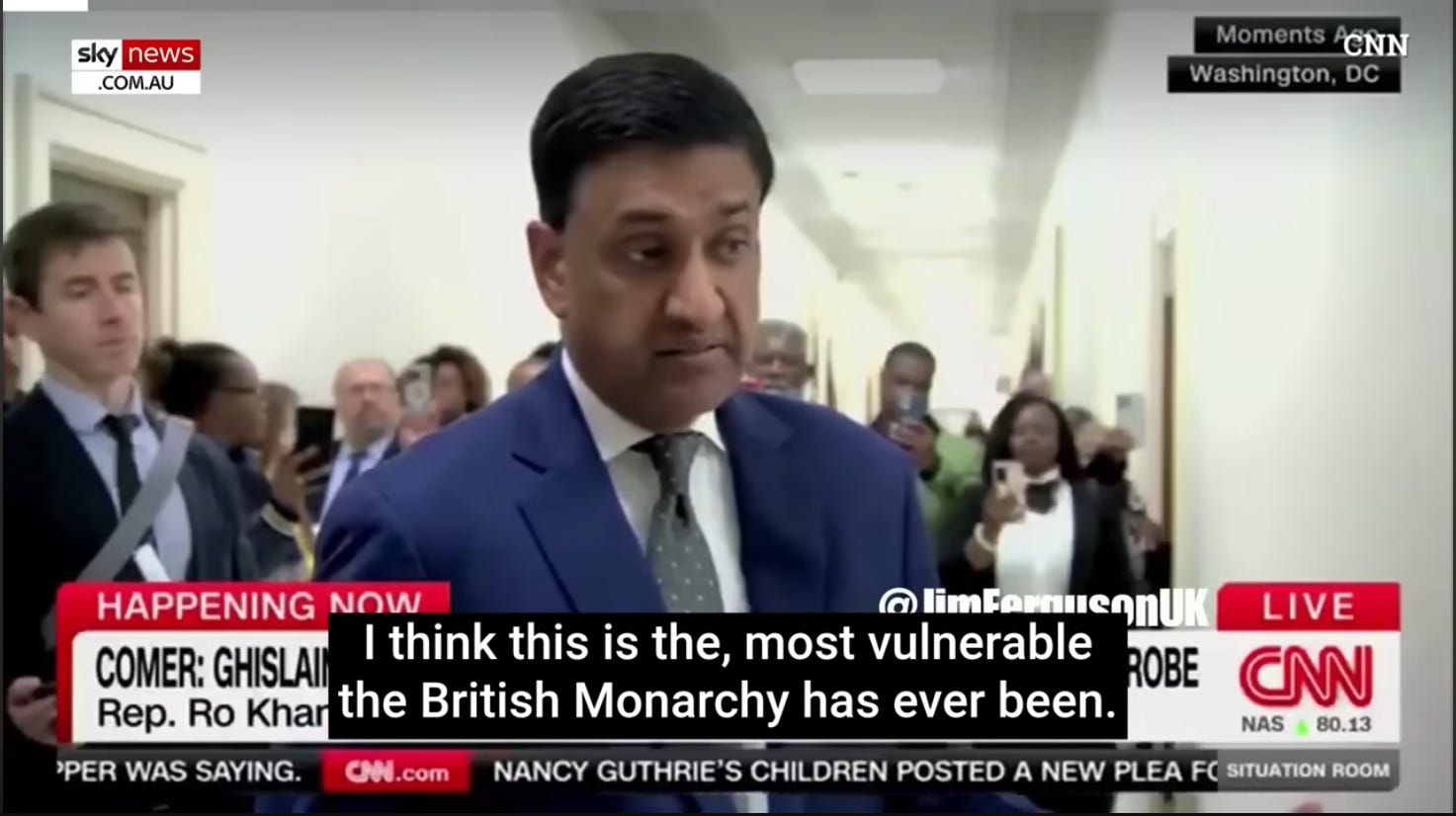
“I think this is the most vulnerable the British monarchy has ever been.
“They ought to ask the king and queen questions, and maybe this will be the end of the monarchy.”
Everyone is debating what this means for King Charles, but here’s what they’re missing.
What’s actually bringing down King Charles and what’s bringing down the Democrats is the very same thing: their fanatical commitment to the green agenda.
This week, Donald Trump drove a stake through the heart of that agenda by launching the largest deregulation effort in American history.

And as usua whenever they are trying to control the narrative, the Democrats don’t want you to see any of that.
They want you to believe that a billionaire class of oligarchs has captured the Trump presidency.
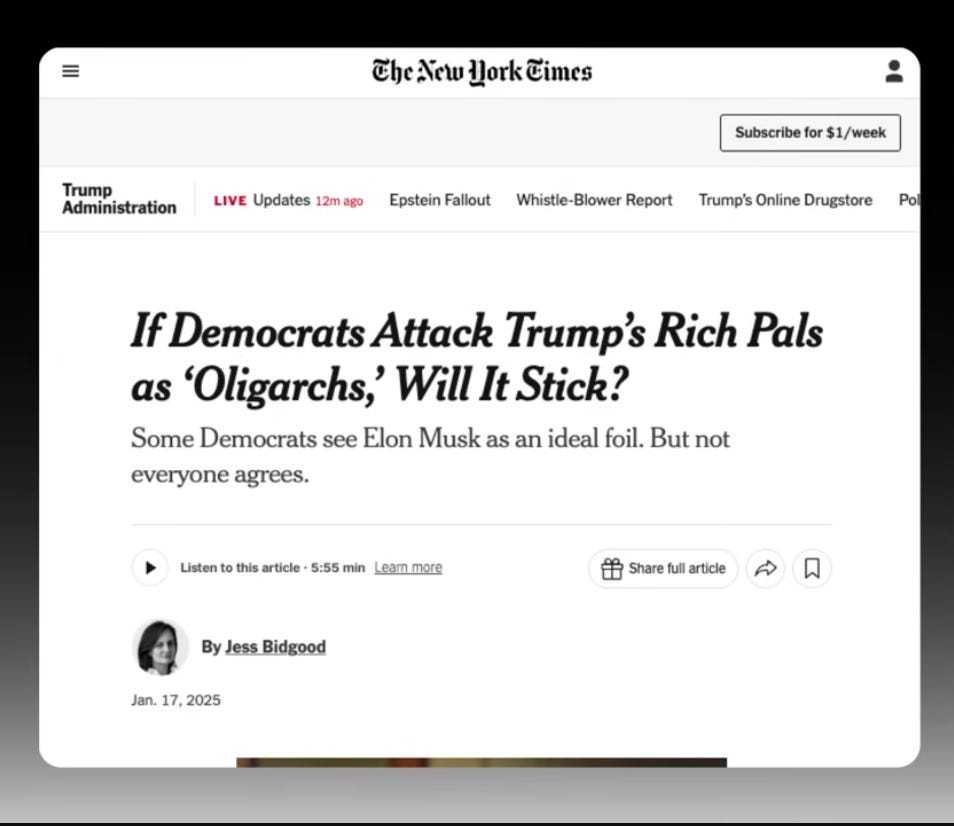
That’s their midterm strategy.
Drown out the factories being built, the jobs being created, the green straitjacket being ripped off the American economy, drowning all of it in scandal and class warfare.

It’s the same playbook the British Empire ran during the French Revolution to destroy a Republican movement from within (globalists are not known for their creativity, just keep pulling something out of a hat that worked before - same furniture, different room).

The “Epstein Class” Weapon: How Democrats Plan to Kill the Trump Revolution (01:37)
During the past few weeks, Ro Kahane (D-CA) has become the face of the Epstein file releases.
Kahanna just didn’t talk about Epstein - he coined a term, the Epstein class, and then he aimed at it.
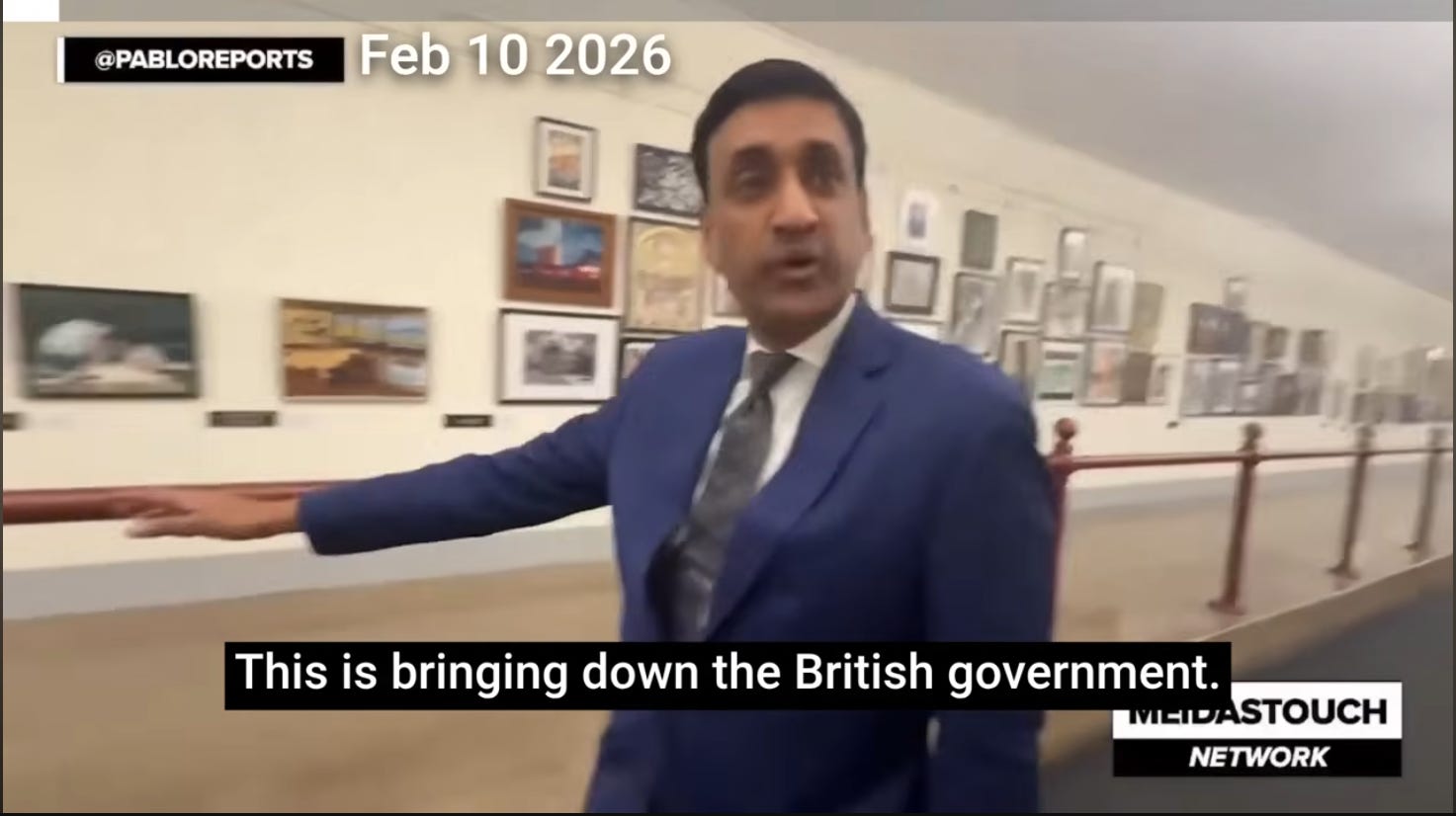
“This is bringing down the British government and they bring down the British monarchy.
“It’s bringing down countries and the elites across the country.
“What are we doing here in the United States to stand up to the Epstein class?
“I mean, we’ve got a commerce secretary who’s all over the Epstein files.
“Where’s the outrage?
“Where’s the outrage at the billionaires? in Silicon Valley, in finance, in Hollywood, going to Epstein’s Island.
“We need moral accountability in the United States,
“just like they’re having in so many other countries around the world.”
Did you catch that pivot?
Kohanna goes from King Charles to Howard Lutnick in one breath - the Commerce Secretary, the man Donald Trump has tasked with implementing the tariff strategy to rebuild American manufacturing.
Kahanna isn’t calling for justice for Epstein’s victims.
He’s building a political weapon and is aimed directly at the people around Trump who are dismantling the globalist economic system.
He isn’t freelancing.
This is the Democratic Party’s chosen strategy for the 2026 midterms.
The New York Times reported in January (in the NYT article referenced above) that the Democrats have unified around a single thing: America has become an oligarchy run by billionaires who have captured the Trump White House.
Think about what they’re saying...
The billionaires cooperating with Trump to rebuild the American economy, the industrialists, the builders, the people putting shovels in the ground, those are the villains,
not the financial parasites who gutted our manufacturing for 50 years,
not the Wall Street speculators who turned American families into permanent renters
In the narrative being controlled by the Democrats, the people actually building things are the enemies now.
Now, why this matters is bigger than the midterms.
The Democrats are doing something very specific.
If they can make you distrust every billionaire and industrialist working with Trump, they can isolate the president from the very people he needs to rebuild the country.
And here’s the irony, they’re hoping you won’t notice.
Ro Khanna represents Silicon Valley.
He has spent his entire career surrounded by that billionaire class.
But now, suddenly, when those billionaires are working with a president who is rebuilding American industry instead of shipping it overseas, now they’re a threat to democracy.
The Green Agenda Is Dead: Trump’s Largest Deregulation in American History (04:35)
Now here’s what the Democrats are really desperate to bury.
Donald Trump just launched the single most devastating blow to the globalist economic system in modern history, and it happened this week.
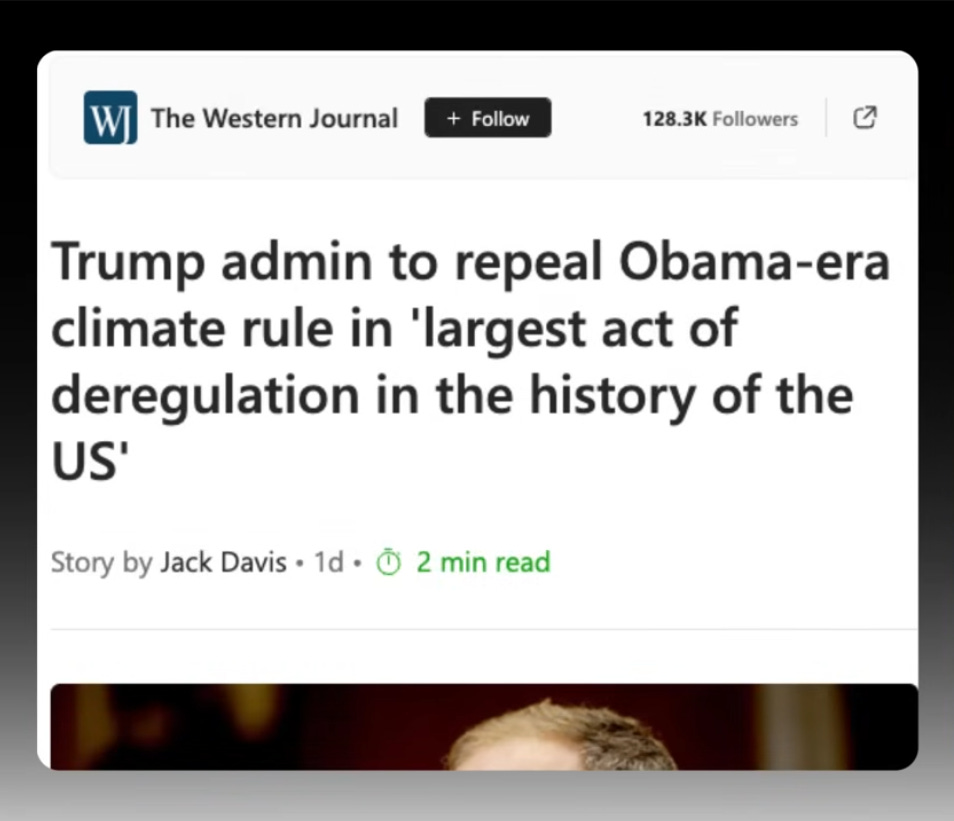
The EPA announced that it is finalizing the repeal of the Obama-era endangerment finding.
If you don’t know what that is, you should - click the image below to discover more…

This single bureaucratic ruling has been the most destructive policy imposed on the American economy in the 21st century.
In 2009, the Obama administration declared that six greenhouse gases, including carbon dioxide, endanger human health and welfare.

That’s it - this ONE finding, and from that single determination flowed trillions of dollars in regulations.
Every rule that forced automakers to build electric vehicles, which no one wanted
Every regulation has stopped the factory from being built
Every mandate that drives up your electricity costs
It all traced back to this one finding.
EPA Administrator Lee Zeldin called this repeal the largest act of deregulation in the history of the United States, and he isn’t exaggerating.
Let me show you what this means in the real world, because it isn’t abstract.
Look at what’s just aired on Fox Business this week.
Marie Bartiromo interviewed the executives behind a brand-new, state-of-the-art strategic mineral-processing facility in Idaho.
A hydrogen plant built by U.S. Antinomi Corporation.
This project came together in ONE YEAR.
Previously on the green regulatory regime, a project like that would never have happened.
The permitting alone would have taken longer than the construction.

“United States Antimoni Corporation is partnering with America’s Gold and Silver Corporation on a massive joint venture to construct a state-of-the-art hydro metallurgical processing facility in Idaho to boost production and control over three key critical minerals for the United States: copper, silver, and antimony.”
Think about what you just heard…
Strategic minerals, the materials essential to everything from defense systems to advanced manufacturing, are being processed on American soil in a facility that went from concept to reality in 12 months.
That is the American system in action.
And it’s not just Idaho.
Across this country, new factories are breaking ground.
Young people are flooding into vocational training programs.
The productive spirit of the American people, which was suffocated for decades under the green agenda, is roaring back to life.
The Democrats’ French Revolution: The British Playbook to Destroy a Republic (07:11)
The Democrats don’t have an economic alternative -
All they have is the mob, scandal, chaos, and class warfare.
And if you want to understand where that playbook comes from, you have to go back to the original, the French Revolution.
After watching the media this week, Barbara couldn’t stop thinking about the French Revolution, as what we’re watching right now is not new; it’s a 200-year-old British operation - and the man who wrote the playbook is named Jeremy Bentham2.
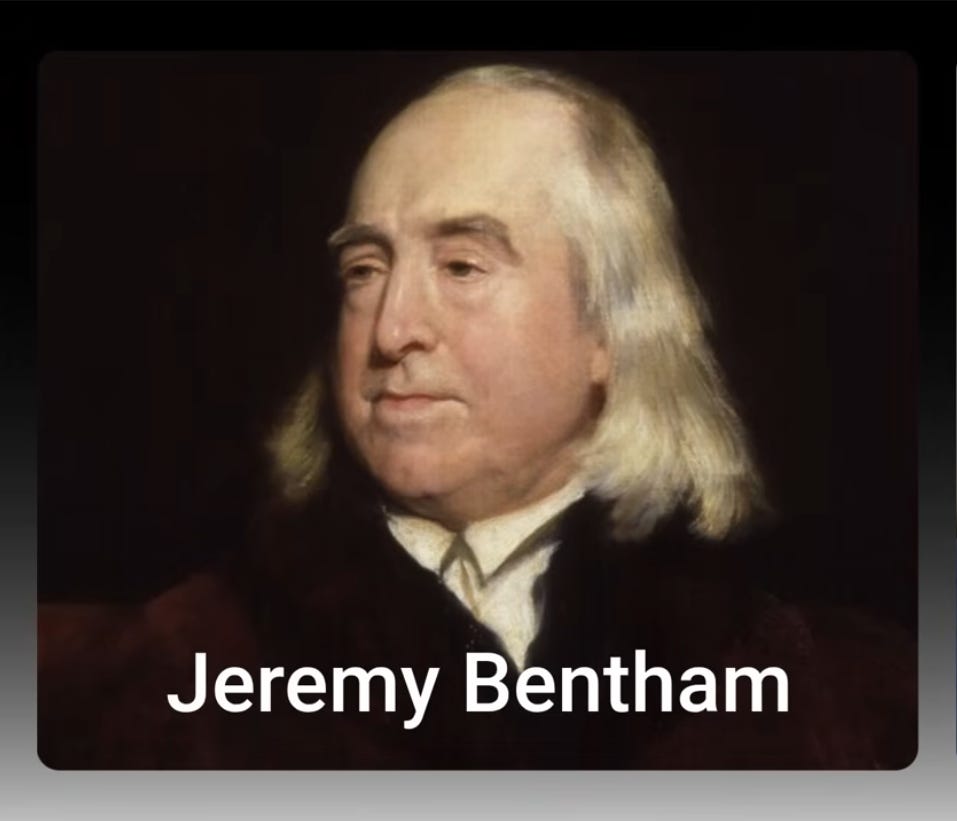
The revolution wasn’t about people rising up against the corrupt monarchy; that’s the storybook version.
It was a British intelligence operation based in London designed to prevent France from adopting the principles of the American Revolution, which had just occurred.
If France had adopted the American system, sovereign credit, industrial development, a productive economy serving the general welfare, Britain’s imperial model of financial control and managed backwardness would have been finished.
So they destroyed France from within, and the man who designed the method was Jeremy Bentham.
Most Americans have never heard of this man, but understanding him will help you understand the present.
Bentham wrote a direct rebuttal to our Declaration of Independence.
He declared that human creativity is impossible, that knowable truth is impossible, that we are nothing but prisoners of our senses, animals responding to pleasure and pain, and nothing more.
Think about what he’s saying.
The Declaration of Independence says that human beings are endowed by their creator with unalienable rights, life, liberty, and the pursuit of happiness, that we can know the truth, that we can create, that we can govern ourselves.
Bentham looked at all of that and said, "Nonsense, you are cattle, and cattle need to be managed."
From that philosophy, he designed a political system.
He called for an absolute dictatorship run not by a king or parliament, but by what he called a Public Opinion Tribunal.
Bentham’s Public Opinion Tribunal had absolute authority.
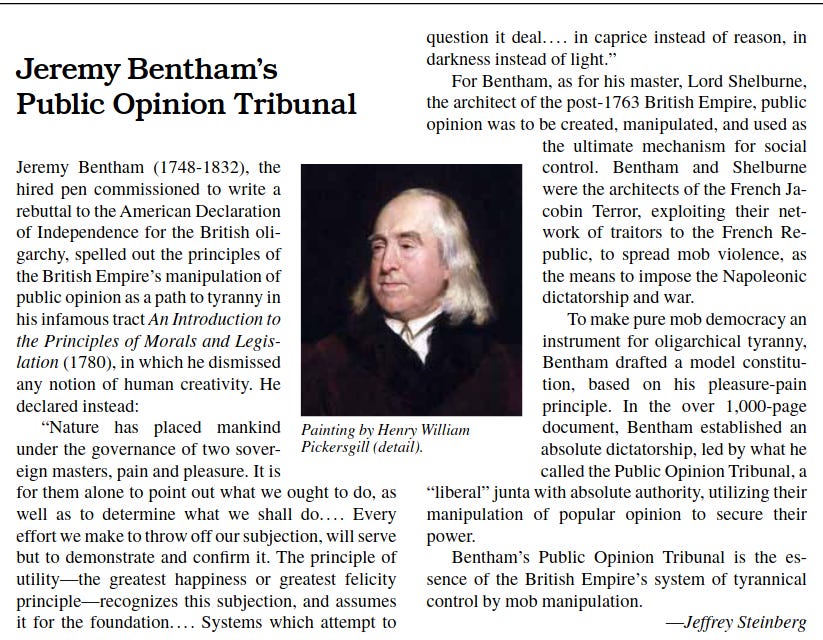
It ruled, obviously, through the manipulation of public opinion.
Bentham laid out a precise mechanism.
You control the press.
You manufacture outrage on demand.
You direct popular rage, not at the empire pulling the strings, but at whatever target serves the empire’s interests.
You mobilize mobs, and anyone who resists, anyone who tries to build, to produce, to lead, is dragged before the court of public opinion and destroyed.
That was the method that turned the French Revolution from a movement for human freedom into the Reign of Terror.
It was funded and directed from London, and its targets weren’t the empire.
Their targets were the people trying to build France into a sovereign, productive nation.
Now look at what the Democrats are doing right now and tell me it’s not the same operation, and just like the French Revolution, the target isn’t corruption.
The target is the productive forces, working with a sovereign leader, to rebuild this country.
But here’s the real difference.
The French didn’t know what hit them - we do.
And this time, the Republic has a president who isn’t playing by its rules.
Bentham’s works are available online at the University College London…

Summary
The British monarchy is crumbling, not under the weight of the Epstein files, but because of the failure of the green agenda.
That agenda, the economic control system that strangled productive nations for half a century, just received a death blow from this administration.
And the Democrats have nothing left but a 200-year-old British playbook of manufactured outrage, mob violence, and public opinion tribunals aimed at the very people rebuilding the country.
For the first time in 80 years, a president is using every lever of power to break the financial parasites and unleash the productive power of the American people: new factories, new processing plants, productive jobs, and affordable energy.
That’s what’s actually happening while they scream about oligarchs.
The French didn’t survive Bentham’s operation; their revolution was hijacked, and the Republic was destroyed from within.
But we have something the French didn’t have - we know who the enemy is.
We refuse to play by their playbook.
We have a president who does the same.
Ro Kahane’s Recent Interview with Shawn Ryan
Shawn is a great guy; however, here he has fallen for Ro’s strategy. Be vigilant and take notes…
If you’re beginning to see that the political battles being shown by the media aren’t the real fight, that the real fight is between those who want to rebuild this country and those who want to keep looting it, then you need to subscribe to Prometean Action’s free newsletter.
Promethean won’t cover the play-by-play; Decisive Liberty News will do so to some level.
Both of us will show you the strategy behind it from the standpoint of the centuries-long battle between empire and sovereign nation-states.
To subscribe to Promethean Action, click the following button…
To Subscribe to Decisive Liberty, click this button…
Recommended Reading
You may have read some of these before. Lately, the game has been jacked up, and we believe rereading or reading them for the first time will help you better understand what is really going on (all links open in our online library)…
The Art of War, Sun Tzu
The Art of War and the Biblical Principles of Spiritual Warfare
The Art of the Deal, Donald Trump
Rules for Radicals, Saul Alinsky
The Cloward-Piven Strategy, Richard Cloward, Frances Fox Piven
Charlie Kirk Proves The Art of the Deal works…
Recommended Reading Related to This Post
HEAR what you are listening to
SEE what you are looking at
Watch the SHELL GAME, not the shells
The French Revolution, a period of significant political and societal change, began with the Estates General of 1789 and concluded with the Coup of 18 Brumaire on November 9, 1799.
Many of its foundational concepts are considered core tenets of liberal democracy and continue to influence modern French political discourse.
The revolution fundamentally altered the relationship between rulers and the governed and redefined political power, challenging established norms in European society.
It transitioned France’s governmental structure from an absolute monarchy to a constitutional monarchy, then to a republic, and ultimately to an oligarchy.
During each phase, the question of who should wield political power was re-evaluated, leading to the establishment of various governing bodies like the National Assembly and the National Convention.
This period also saw the monarchy replaced by the French First Republic in September 1792, followed by the execution of Louis XVI in January 1793.
The revolution was influenced by enlightened thinking, with many questioning the divine right of kings and the rule of a privileged few over the majority.
A financial crisis, partly due to France’s involvement in the American Revolutionary War, led King Louis XVI to call the Estates General in 1789 to approve new tax laws. This crisis was a significant factor in the outbreak of the revolution.
The storming of the Bastille on July 14, 1789, is often cited as the beginning of the revolution, a symbolic act where the crowd challenged what seemed an immovable power.
The ideas of representational democracy and basic property rights took root during this period, ultimately paving the way for the end of monarchies and influencing subsequent political upheavals in France throughout the 19th century.
While there wasn’t a predefined manifesto or program, revolutionaries often had to make decisions in real time.
For instance, Napoleon Bonaparte’s strategic leadership in the Toulon Campaign, where he directed artillery to expel British forces, demonstrated the critical military actions during the revolution.
His success in this campaign, which was vital for the revolution’s survival, led to his rapid promotion.
This period also saw counter-revolutionary movements, such as the revolt in the Vendée against the National Convention, indicating internal conflicts within the revolution.
The French Revolution also had a profound impact on its colonies, sparking the Haitian Revolution in August 1791, as enslaved people revolted against the colonial system, inspired by the radicalizing events in France
Jeremy Bentham, an English philosopher born in 1748, was declared an honorary citizen of France in September 1792 due to his correspondence with leaders of the French Revolution, including Mirabeau.
Bentham welcomed both the American and French Revolutions, despite his opposition to the concept of natural rights articulated in documents such as the 1789 French Declaration of the Rights of Man.
He saw the French Revolution as a significant opportunity to influence the reconstruction of the French state and advised French legislators on how to reform it, drawing on the example of the British Constitution.
In the early stages of the French Revolution, Bentham wrote materials that appeared to justify equality of suffrage on utilitarian grounds.
He addressed political reform during this period, even advocating for democratic suffrage, including women’s suffrage, in a draft constitution for France.
However, as the revolution became more extreme, Bentham argued against political reform in Britain, though he continued to support extensive legal reform.
Bentham’s writings for the French Revolution focused on rights, representation, and reform.
His work, Anarchical Fallacies, later known as Nonsense upon Stilts, was a critique of natural rights, arguing that they provided an unstable foundation for legal and political systems.
His ideas, including the concept of the panopticon - a prison design in which inmates believe they are constantly watched, leading to self-regulation - were later used by the philosopher Michel Foucault to describe state repression and surveillance.
Perspectives
Bentham’s Influence and Radicalism
Bentham’s commitment to democracy during the early French Revolution, including his justification for equality of suffrage on utilitarian grounds, is subject to differing interpretations regarding its extent and depth.
Bentham’s critical utilitarianism, rather than the events of the French Revolution, may have ultimately been responsible for his move towards a novel form of radical politics.
He offered advice to French legislators on reforming the state, suggesting they learn from the British Constitution, and at his most radical phase in 1789, he advocated for extensive electoral reform.
Bentham viewed the French Revolution as a crucial opportunity to influence the reconstruction of the French state, and he was working on specific French problems, distinguishing them from British issues.
Critiques of the French Revolution’s Ideals (which also fits the democrats desire to destroy the U.S.)
The French Revolution, unlike the American Revolution, was built on utopian ideas of human freedoms linked to the self rather than to God, leading to a dystopian outcome marked by terror and oppression.
Mont Saint-Michel, a former royal prison, became a symbol during the French Revolution, reflecting the struggle against monarchy, while also serving as a cautionary example of radicalism and the importance of order and the rule of law.
The revolution saw the establishment of an altar to the goddess Reason in Notre Dame, influenced by Voltaire’s anti-Christian sentiments, which contributed to a violent rejection of Christianity.
Revolutions are complex and involve brutalities and tragedies, which should be compared to the brutalities of the status quo they aim to overturn.


