
As We Have Enough Oil, Why Are We In Iran?
SEE what you are looking at, HEAR what you are listening to, watch the SHELL GAME not the shells...

The Size of Iran Compared to the USA
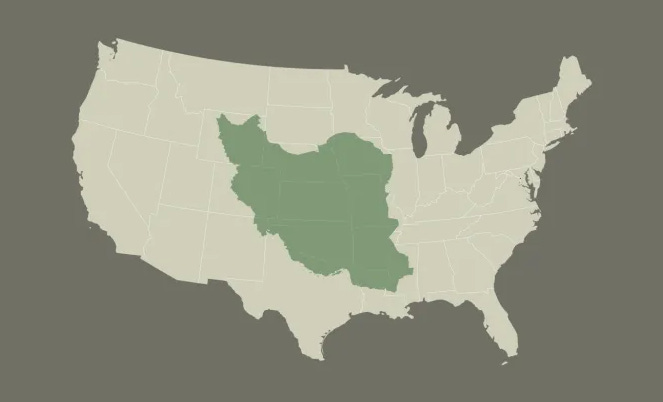
In comparison, Israel is the size of New Jerey…
Strait of Hormuz is Not Why
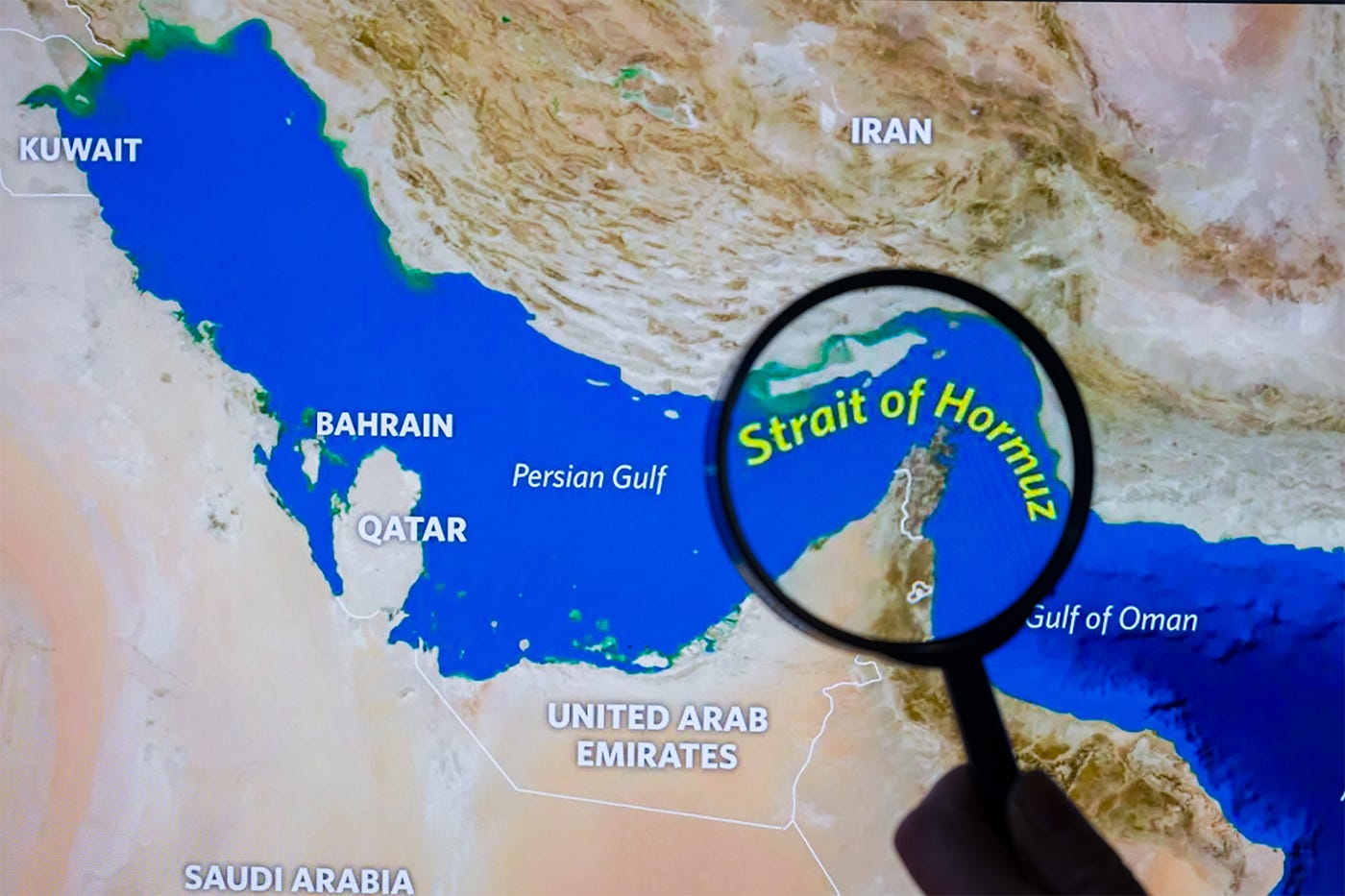
We don’t need their oil, less than 1% of the oil that goes through the Strait of Hormuz arrives in the U.S.
Globally, Europe receives 14% of their oil through the Strait while Asia receives 80% of their oil through the Strait.
Our reason for being in Iran makes any geographical stronghold or chokepoint susceptible to our present there.
Remember Their Adamancy About Growing Their Enriched Uranium Inventory?
They said they were only enriching their supply of uranium for producing electricity… as most are unfamiliar with this process, here’s an overview of the process .
This post is to help you understand how the process has allowed Khomeini gain weapon-grade uranium as well as he should have been stopped in the first place - he wasn’t as too many Leftists thought it would be unnecessary at that we should take the Khomeini’s word [have you ever seen a Leftist’s or globalist display wisdom and discernment?]
It is important for as many to know as possible as the general public will better understand better just how close we were to a nuclear war - and no, I am not parroting President Trump, I am providing the evidence and the science knnowledge he had to make such a statement.
The process of making uranium usable for nuclear power or for nuclear bombs is the same.
It begins with mining uranium ore from the earth (major global suppliers include but are not limited to Kazakhstan, Canada, Australia, and Namibia).
In the Middle East, Iran is believed to possess large reserves of uranium in various locations, including Bandar Abbas, Yazd, North Khorasan, and Iranian Azerbaijan.
Now, naturally occurring uranium primarily consists of two isotopes: uranium-238 (about 99.3%) and uranium-235 (about 0.7%).
Uranium-235 is the key isotope for nuclear reactions, as it is fissile, meaning it can sustain a chain reaction.
To increase the concentration of uranium-235, the uranium undergoes a process called enrichment.
Before enrichment, the mined uranium, often in a powder form known as yellowcake (U3O8), is chemically processed and converted into uranium hexafluoride gas.
What Is Uranium Enrichment?
Uranium enrichment is a critical step that increases the proportion of uranium-235.
This is typically achieved using high-speed centrifuges, which separate the isotopes based on their mass.
FOR NUCLEAR POWER REACTORS, uranium is usually enriched to a lower level, between 3% and 5% uranium-235, which is sufficient to sustain a controlled chain reaction for electricity generation.
In contrast, FOR NUCLEAER WEAPONS, uranium must be highly enriched, typically to 90% or more uranium-235, to create an explosive chain reaction.
Achieving this higher level of enrichment, often referred to as weapons-grade uranium, requires significantly more effort and specialized technology.
How Much Weapon-Grade Uranium Did Iran Have?
In May 2019, Iranian leaders announced an intention to increase uranium production by 400%.
While Iranian scientists claim the capability to build a nuclear bomb, they state their program is for peaceful energy purposes, aiming to meet domestic energy needs and allow for oil export.
The United Nations Nuclear Watchdog Agency reported in June 2025 that nearly 900 pounds of Iran’s enriched uranium were unaccounted for, which is enough for approximately 10 nuclear bombs.
Enriched uranium to 60% has no practical civilian application, and Iran has been able to produce enough highly enriched uranium to build at least one bomb monthly.
This material was last known to be in an underground facility in Isfahan, which was heavily bombed in March 2026 (the uranium was blown apart but still at 60%, it will be collected by U.S. troops once the IRGC has been eliminated).
A critical mass of 14 to 40 kilograms (30 to 80 lbs) of 90% to 95% enriched uranium is needed for a nuclear bomb, depending on the power of the bomb desired…
As of June 2025, per the International Atomic Energy Agency (IAEA), Iran had processed 440 kg of Uranium (almost 1/2 ton) to a grade of 60% and getting from 60 to 90% takes only 12-14 days, 90% being the grade needed for a nuclear bomb.
As Khomeini’s history shows full evidence Iran will always go for the jugular, they had enough for 11 nuclear bombs.
How Was Iran Going To Deliver Nuclear Warheads?
Missiles, of course, and until last week, it was widely thought their maximum reach was 1,250 miles.
This map displays cities within 1,000 miles…
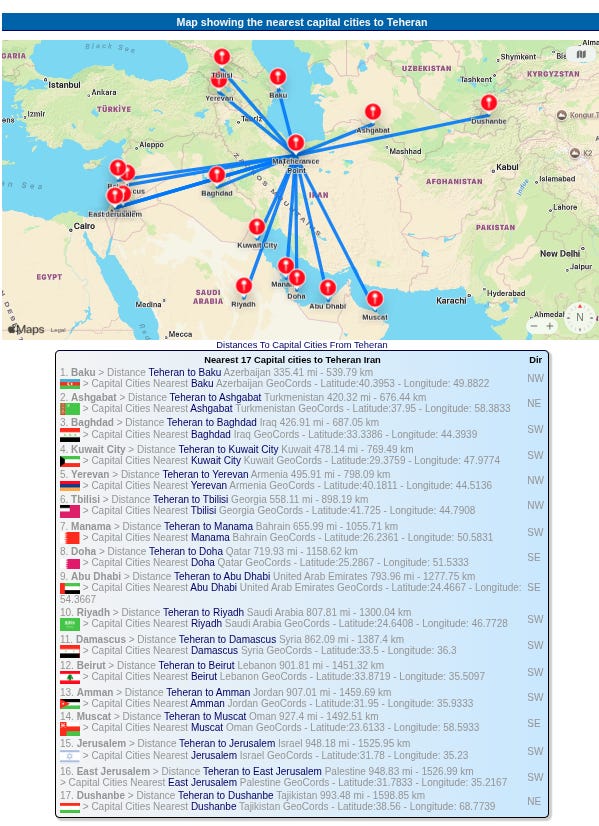
Iran recently fired intermediate-range ballistic missiles at Diego Garcia, a joint U.S.-U.K. military base in the Indian Ocean.
Meaning, the missiles Iran used were capable of at least reaching 4,000 kilometers (2,500 miles) from Iran.
This capability meant that missiles launched from Tehran could potentially reach major cities in Western Europe and parts of Scandinavia such as, but are not limited to, London, Paris, and Berlin.
This range also extends to parts of North and East Africa, such as Kenya and Ethiopia, and South Asian countries like Bangladesh and India, and even parts of China.
Washington D.C. and NYC are more than 6000 miles from Iran - that doesn’t mean we are safe from Iran, there are sleeper cells all over our country thanks to both Obama and Biden (the known sleeper cells are being tracked, how may more there are is still being pursued - dirty bomb anyone?).
This event marked an escalation in Iran’s military capabilities and and affirmed the suspicions of the U.S. government and the world, highlighting previously undisclosed missile technology.
While Iranian officials have sometimes denied launching these missiles or suggested they were launched by Israel, reports from various news outlets and statements from military officials confirm the launches.
Some military experts and observers agree that Iran has successfully launched long-range missiles, despite skepticism about the regime’s overall credibility.
The launch of these missiles demonstrates Iran’s ability to develop longer-range missile technology, potentially building on their successes in launching satellites into space.
The missile used in the strike on Diego Garcia was possibly a modified version of the Khorramshahr ballistic missile, or a two-stage intercontinental ballistic missile.
The Khorramshahr-4/Kheibar, which debuted in 2023, was previously said to have a maximum range of 2,000 kilometers (1,250 miles), but the possibility of a longer reach has been raised.
Iranian officials have stated that they have reduced the missile’s size from its initial version, which also reduced its propellant mass and range (question - when has any sovereignty as aggressive as Iran reduce their destructive capabilities? Yeah, THAT).
However, some theories suggest that Iran might be underestimating the missile’s range to avoid raising concerns in Europe about their missile program.
Iran has also unveiled other hypersonic ballistic missiles like the Fattah-1 and Fattah-2, with the Fattah-1 having a claimed range of 1,400 km (870 miles) and the Khorramshahr-4 having an approximate range of 2,000 km (1240 miles).
Iran Was Within 2 Weeks of Starting a Nuclear War - Thereby the World as Well
If Israel was attacked by Iran with a nuclear warhead, then they would have no choice - no matter what the U.N., NATO or the EU says - but to retaliate in equal or greater force; and without a doubt Iran would send more nuclear warheads into Israel with Israel replying in kind.
Needless to say, the U.S. would definitely become involved, assisting Israel and destroying Iran even more so than we have now.
It doesn’t take a rocket scientist to know that the human carnage of such an would be staggering - and the effects lasting several decades.
That alone would kick off a fiasco history has never seen - nor do we ever want to see.
There are many who will say it would only occur in the reach of Iran - they said the same thing about WWI and WWII.
Any war that has a effects, especially a war event that accomplishes wide devastation in short order immediately puts ALL nations on high alert and in a very strong defensive posture.
Not all leaders nor military react the same - but all, especially should their be a nuclear warhead being set off anywhere, nations will act with impunty and as full a force as they can deliver.
As of early 2026, NINE countries possess nuclear weapons…
United States
Russia
China
France
India
Israel
North Korea
Pakistan
U.K.
The combined global inventory of nuclear warheads is approximately 12,187 to 13,080.
The United States and Russia together possess the majority of these weapons, holding about 86% of the world’s total inventory and 83% of the stockpiled warheads available for military use.
While the total number of nuclear weapons has decreased from a peak of over 70,000 during the Cold War in the mid-1980s, the number of operational nuclear weapons ready for use has been steadily increasing.
Unanswered Questions
Has Iran shared their uranium stock and/or technology with other Muslim countries?
There is no explicit information indicating that Iran has shared its uranium stock or nuclear technology with other Muslim countries.
While the documents detail Iran’s advancements in uranium enrichment and its nuclear program, including the accumulation of enriched uranium and the development of centrifuges, there is no mention of these materials or technologies being transferred to other nations.
Instead, the focus is on Iran’s internal program and its interactions with international bodies and other major powers regarding its nuclear activities.
It is known that Iran itself has received assistance and technology from various countries, including China, Russia, and Pakistan, for its nuclear program.
For example, China is believed to have been the source of Saghand mining technology, and Russia has expressed readiness to support Iran’s nuclear program.
However, these instances describe Iran as a recipient of nuclear assistance, not a provider to other Muslim countries.
The documents also mention that some Arab countries, such as Egypt, Morocco, and Saudi Arabia, have expressed interest in acquiring nuclear technology in response to Iran’s program, but there is no information about Iran directly supplying them.
Does Iran have even more powerful missiles in their arsenal?
Regarding missile technology,Iran has been focused on building nuclear warheads and while improving missiles has remained a second priority.
For this, Iran has been dependent upon their connections with Russia, North Korea, and China for years.
So, Why are We in Iran?
If you still are clueless as to why, reread all this until you do know why…
If you still are clueless, well, let us know and we will start praying for you…
The thought of these maniacs with their hands on a nuclear bomb.
Excellent! Thank you for sharing, Garrett.