

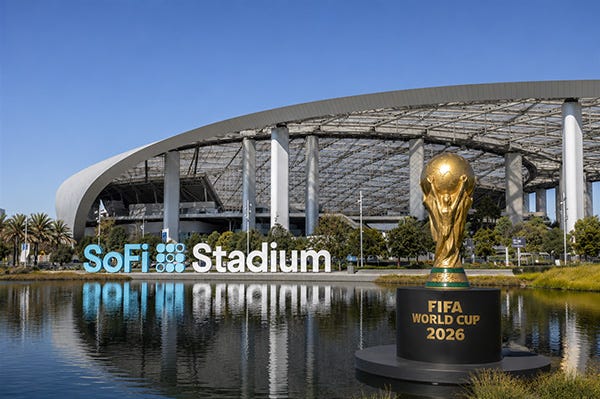
The 2026 FIFA World Cup opens in the United States on June 12 with the US facing Paraguay at SoFi Stadium in Inglewood, California.
Group D play marks the start of 78 matches across 11 US host cities over 39 days, drawing millions of fans and international visitors.
DHS and the FBI have classified the event as a high-value target, with security measures scaled to match the elevated risk from foreign terrorists, domestic extremists, and opportunistic agitators.
DHS Secretary Markwayne Mullin warned Thursday that the threat level surrounding the 2026 FIFA World Cup is “extremely high.”
Officials have described the operation as equivalent to securing 78 consecutive Super Bowls.
A White House Task Force is coordinating the massive federal, state and local security effort.
Every FBI field office is in a state of heightened readiness, with tactical teams prepared for immediate deployment against any threat scenario.
Drone are receiving top priority.
The FAA has established strict no-drone zones around all stadiums, fan festivals, and training sites.
On match days, the restriction extends to a 3-nautical-mile radius up to 3,000 feet, with lighter rules in effect otherwise. Violations carry massive fines, drone seizure, and potential jail time.
Countermeasures include RF detection, jamming systems, and kinetic interceptors, funded through DHS grants. Illegal drone activity near venues is now treated as a national security matter.
Jihadist threats remain explicit and active.
ISIS propaganda continues to urge mass-casualty operations against the tournament, while Al Qaeda’s Inspire magazine provides tactical guidance for lone-wolf attacks in the West.
Groups such as ISIS K, Al Qaeda in the Arabian Peninsula, and al Shabaab maintain an external operations focus.
Intelligence assessments identify homegrown violent extremists as the most probable actors, capable of employing firearms, vehicles, or improvised explosive devices against soft targets including fan zones, transit hubs, hotels, and public viewing areas.
Additional risks come from state-linked actors.
Iran continues to pursue transnational repression through proxies.
Mexican cartels, recently designated as foreign terrorist organizations, maintain interest in southern venues.
Domestically, ANTIFA-affiliated and left-wing networks, energized by the ongoing ICE facility protests in Newark and elsewhere, have signaled their intent to exploit the FIFA events.
Demonstrations tied to immigration enforcement or perceived political grievances could escalate into physical blockades, property damage, or direct interference with operations.
Recent intelligence links anti-government violence directly to current border enforcement actions, creating ready-made flashpoints for disruption under media coverage.
DHS and FBI statements are direct: Soft targets outside the stadium perimeters represent the primary vulnerability.
Intelligence fusion, aggressive vetting, and rapid response remain central.
There is no tolerance indicated for sanctuary jurisdiction interference or operational delays.
For field personnel, the requirements are unambiguous:
maintain overwhelming presence
enforce strict perimeter control, and
apply rules of engagement that enable decisive action
Jihadist operatives, drone threats, and domestic agitators view American openness as an exploitable weakness.
The opening match at SoFi Stadium serves as the first operational test of whether federal authority will prevail.