
The Kurds May Be One of the More Vital Answers to Iran's Future

Who Are the Kurds?
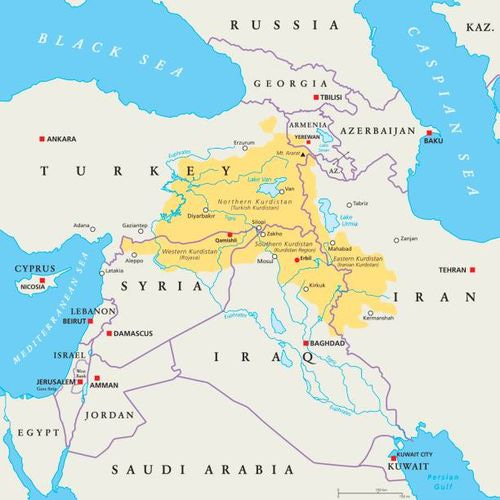
The Kurds are an Indo-European ethnic group from West Asia and are considered one of the largest stateless ethnic groups in the world, with populations estimated at 25-45 million.
They are indigenous to a mountainous geographic region known as Kurdistan, which spans parts of southeastern Turkey, northwestern Iran, northern Iraq, and northeastern Syria.
Kurds speak their own language, with several dialects, and most are Sunni Muslims, though some communities include followers of Shia Islam, Alevism, Yazidism, and Christianity.
Historically, Kurds have been a stateless nation, often subjected to repression and violence in the countries where they reside.
The prospect of Kurdish independence has been a source of ethnic and political tension in West Asia since the 19th century, with nationalism emerging in the 1890s as the Ottoman Empire weakened.
Promises of an independent homeland, often referred to as Kurdistan, were made by world powers after World War I and the collapse of the Ottoman Empire, but these aspirations were never realized.
While they have never had their own state, Kurds govern a semi-autonomous area in northern Iraq and, for years, de facto ruled much of northeastern Syria.
The Kurds have a long history of grievances and rebellions against various regimes, including the current Islamic Republic of Iran.
Their homegrown militia, known as the Peshmerga, has a reputation as an effective fighting force.
In recent years, Kurdish forces have been crucial allies to the United States in the Middle East, particularly in the fight against ISIS.
However, this alliance has also been marked by instances where Kurds felt betrayed or abandoned by their allies.
The Kurds Could Serve A Vital Role to Iran’s Future
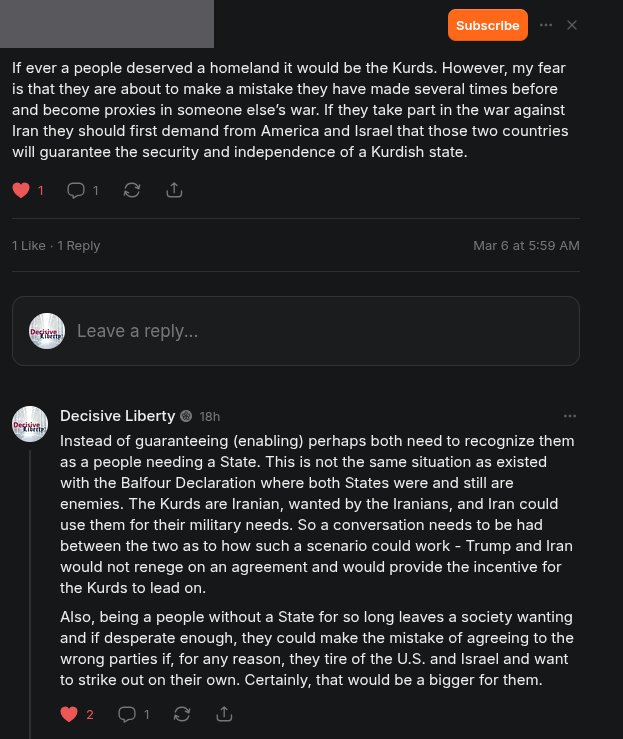
A comment provided by a subscriber who shall remain nameless concerning the role of the Kurds…
As the exiled Prince of Iran, Reza Pahlavi, is due to head up Iran's transition, he would have to be included in talks between the Kurds and the United States (most likely the President and Marco Rubio).
The Kurds would also have been accepted by the people of Iran, which is most likely a shoo-in, as the Kurds are highly respected and loved by the Iranian people; still, a vote by the people should be undertaken for the sake of formality and recognition.
Whoever will be the long-term leader of Iran will then have a well-militarized country in which the people of Iran and the Kurds are united.
There are other details to work out, but I believe this is what is needed from what we now know.