
The Financial Times Got It Wrong... Again...

ICYMI - The Financial Times is the right arm of the City of London1, which controls ALL the central banks globally. Doing a deep dive on the City of London will leave you overwhelmed.
Just yesterday, the messed up…
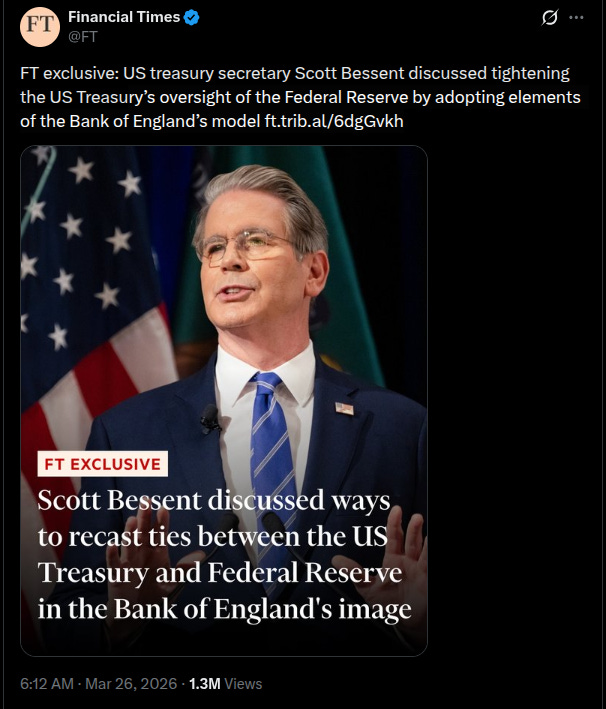
U.S. Treasury Secretary - who has noted multiple times that 50% of his job is national security - corrected the record on his X account…
By publishing this explicitly false story, the @FT (on X) has officially become tabloid trash for market participants.
Despite my direct, on-the-record denial of ever having advocated, explored, or espoused the idea that the Chancellor-Bank of England statute serves as a prototype for a Treasury-Federal Reserve relationship, FT journalists manufactured a story with the headline, “Scott Bessent praised Bank of England as model for tighter oversight of the Federal Reserve.”
These pathetic journalists have clearly fabricated a story to give the impression that the Trump Administration and I are setting “about restructuring the relationship… at a time when President Donald Trump has launched an unprecedented assault on the world’s most important central bank.”
Their mendacious assertion is based on vague statements from unnamed “financial industry executives familiar with the matter.”
In short, FT has literally manufactured an entirely fake policy position for the Administration and me. Aside from furthering a maliciously false narrative of dysfunction and divisiveness, it baffles the mind why they would shred their already diminished journalistic credibility.
Over the past 10 years, I have written more than 20,000 words opining on the Federal Reserve decisions, personnel, structure, and modifications. Nowhere have I ever mentioned this ridiculous notion.
The Governor’s letters to the Chancellor have proven to be a useless and perfunctory device.
There is much to be said about the storied Bank of England, but any recreation of its operating framework on this side of the Atlantic has never been contemplated.
The shameful journalists and editors at the FT are shocking in their meretriciousness, lack of standards, and general intellectual libertinism. It is the worst tradition of Fleet Street to manufacture news rather than report on it.
They have brought irredeemable shame to their parent organization, Nikkei Inc., with whom I had previously held excellent relations.
In 2025, I laid out a comprehensive 6,000+-word review of each and every policy reform that I believe the Federal Reserve should adopt.
Read my actual, real thoughts on and proposals for Federal Reserve reform at the International Economy:
Opens in our online library, the original linke is here:
https://www.international-economy.com/TIE_Sp25_Bessent.pdf
In other words, DON’T misquote Scott Bessent, especially if you are the British Empire...
The City of London, often called “the City” or “the Square Mile,” is a unique local authority area and ceremonial county in England. It forms the historic center of the broader London metropolis, established by the Romans around 47 AD as Londinium. Historically, it constituted the majority of London from its Roman settlement until the Middle Ages. Today, it serves as one of London’s primary central business districts, alongside Canary Wharf and the West End, and is a leading global financial center. The Bank of England and the London Stock Exchange are both located within the City. The City of London Corporation governs this area and is led by the Lord Mayor of London.
Within its approximately 1.12 square miles, the City of London has about 8,000 residents, but a much larger working population of around 550,000 people. It also attracts approximately 10 million annual visitors. Notable historic sites within or immediately bordering the City include St Paul’s Cathedral, the Royal Exchange, Mansion House, and the Tower of London, a 1,000-year-old castle that houses the Crown Jewels. The Strand, a historically significant street connecting Trafalgar Square to Temple Bar, also showcases centuries of British history and culture.