
National Safety vs. Moral Considerations


Full text…
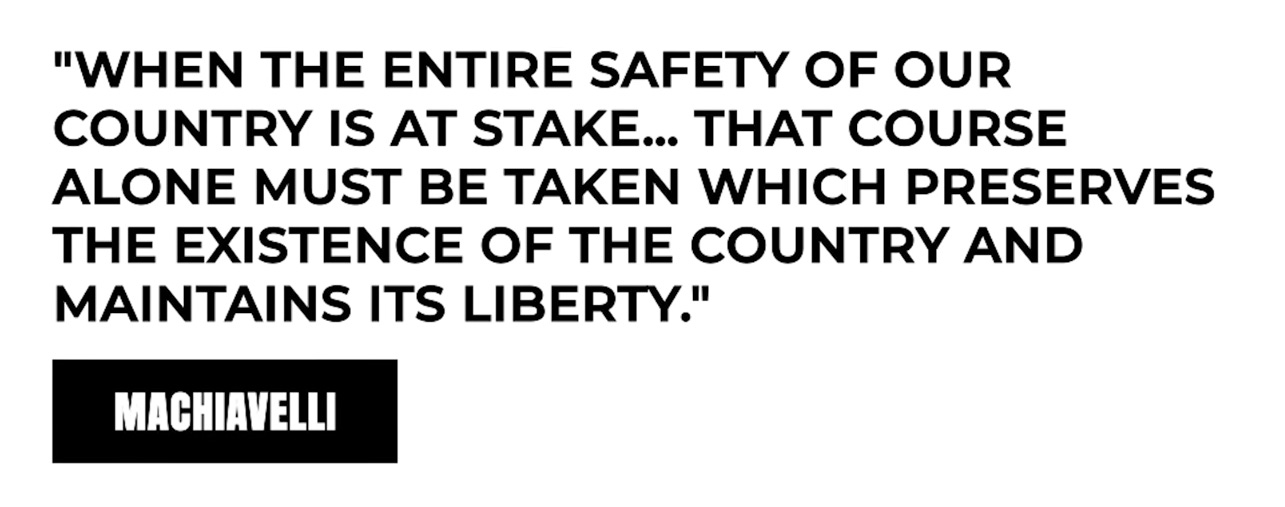
'“… when the entire safety of our country is at stake, no consideration of what is just or unjust, merciful or cruel, praiseworthy or shameful, must intervene. On the contrary, every other consideration being set aside, that course alone must be taken which preserves the existence of the country and maintains its liberty.”
On November 13, 1787 Thomas Jefferson wrote a letter to John Adams' son-in-law, William Smith, from which can be found the following…
“What country before ever existed a century and half without a rebellion? And what country can preserve it’s liberties if their rulers are not warned from time to time that their people preserve the spirit of resistance? Let them take arms. The remedy is to set them right as to facts, pardon and pacify them. What signify a few lives lost in a century or two? …
"The tree of liberty must be refreshed from time to time
with the blood of patriots and tyrants. It is it’s natural manure."
~ Thomas Jefferson
When a country’s safety is at stake, the preservation of the nation’s existence and liberty is prioritized, potentially leading to a focus on self-preservation at the nation-state level. Individuals are encouraged to protect each other, treating one another with kindness and civility, listening to opposing views, and refraining from violence and threats of violence.
Citizens (NOT the government) should work to preserve liberty and pursue happiness, which are considered unalienable rights.
It is necessary to develop the intellectual and moral faculties of individuals to perfect society, and the desire to better one’s condition is seen as a key motivator for progress and civilization.
Liberty and security are indispensable for this purpose, allowing individuals to pursue their interests and happiness while being assured they will not be deprived of the fruits of their efforts.
The defense of America and the protection of liberty within the country are considered top political priorities.
Perspectives
Prioritizing national safety and self-preservation above all else
At the nation-state level, the primary objective is to keep the nation safe, and morality can be flexible to achieve this goal.
The government’s role is to serve itself, and individuals operating within its confines will not be hindered, but attempting to go outside established norms can lead to difficulties.
Prioritizing America’s defense and liberty in its own country should come before aggressive foreign interventions, shifting away from imperialism towards leading by example.
If everything is made about safety, the public can be easily manipulated by threats, highlighting the need to recognize other values besides safety.
Balancing national safety with moral principles and human dignity
Maintaining national safety, such as at the U.S. southern border, must not compromise human dignity, and policies should respect human life and alleviate suffering.
It is crucial to uphold moral principles and avoid collectivistic thinking during times of escalating conflict, recognizing the difference between intentional harm and collateral damage.
The spiritual toll of witnessing state-sanctioned violence and dehumanization is significant, emphasizing the importance of staying vigilant and calling out injustice.
The argument that saving lives justifies any infringement, such as violating bodily autonomy, must be rejected, as it implies government authority over life itself.