
KrisAnne Hall: SCOTUS and Their Pathetic Birthright Citizenship Errors
ADDENDUM 02-Jul - pertinent and important content from KrisAnne Hall

First, a couple of reminders: SCOTUS cannot make law, they can only render an opinion & has no enforcement ability.
Andrew Jackson pointed out there are 4 equal opinions…
SCOTUS, POTUS, Congress & the States (opens in UVA | Miller Center).
Also see Article II, Section 1 of the U.S. Constitution. Presidential oath (opens in Constitution.Congress.Gov)
As posted on KrisAnne’s X account…
SCOTUS relies on the 14th Amendment to justify Birthright Citizenship while ignoring the limits the 14th Amendment places upon its own authority.
Section 5 of the 14th Amendment reads:
“The Congress shall have power to enforce, by appropriate legislation, the provisions of this article.”
Congress has NEVER enacted legislation granting Birthright Citizenship to the children of temporary visitors or those unlawfully present in the United States.
SCOTUS has the authority to review executive orders and determine whether they are constitutional. That is where its authority ends.
SCOTUS does NOT have the authority to write the legislation Congress never enacted.
If Birthright Citizenship extends to the children of temporary visitors or those unlawfully present, the Constitution assigns that decision to Congress not the courts.
By creating through judicial opinion what the Constitution assigns to the legislative branch, the majority has violated the separation of powers and exceeded its constitutional authority.
That is not constitutional interpretation - that is judicial legislation
SCOTUS says the history of Jus Soli establishes that everyone born on American soil regardless of parental legal status automatically becomes a citizen.
However, factually and historically, Jus Soli is a legal doctrine developed by kings and conquerors to expand political power by creating subjects.
I find it disturbingly ironic that the liberal Justices, who claim to see slavery and oppression in every corner of American history, completely overlook the genuinely feudal origins of this doctrine.
This is what happens when history and the Constitution are replaced with political mythology.
Children are born subject to their parents, not to government. It’s a parental authority issue, not a government jurisdiction issue.
Government does not become a child’s master simply because they first draw breath within a particular border.
Even Great Britain, the very nation the majority relies upon to bind us to this feudal doctrine, has abandoned unconditional birthright citizenship.
Americans rejected the notion that people are born owing unconditional and perpetual allegiance to kings and governments when we declared Independence.
We rejected it again when we established a constitutional republic where citizenship is founded upon law, consent, and allegiance, not the accident of geography.
Now, through an astonishing ignorance of both history and constitutional principle, the majority has resurrected the very feudal philosophy our Founders rejected.
It is a political doctrine that says government owns your political allegiance from the moment of your birth, regardless of the allegiance of your parents.
That is the doctrine of kings and oppressors and therefore patently unAmerican.
If SCOTUS will, through an unfathomable depth of ignorance for political reasons, voluntarily adopt such despotism are we also going to overturn Dredd Scott in some creative but imaginative way that will become championed by the very people it once oppressed?
Every generation that abandons discernment eventually discovers the same truth: unintended consequences are monsters that never stay under your control. Eventually, they turn on their creators.
ADDENDUM 02-Jul
Addendum starts here…
The majority claims the 14th Amendment is clear, YET the members of the Senate who wrote and ratified it prove otherwise.
Senator Jacob Howard, who introduced the Citizenship Clause, expressly stated that it “will not…include persons born in the United States who are foreigners [or] aliens.”
The Senate repeatedly affirmed the same principle throughout the ratification debate.
The Senators who wrote the 14th Amendment, in clear English, established by INTENT.
The constitutional standard is jurisdiction, complete political allegiance to the United States, not geography.
A child cannot legally declare allegiance as they are not sovereign in the eyes of the law!
That is why the debates repeatedly distinguished foreigners, aliens, tribal Indians, diplomats, and others who owed allegiance elsewhere.
Repeatedly.
The authors of the 14th Amendment understood the difference between being physically present in the United States and being completely subject to its political jurisdiction.
Once again the Majority cherry picks history to make its politically driven conclusions rather than admitting that history is clear, the drafters were clear, and the point was established through repetition for the defining point:
Citizenship did NOT attach merely because a child happened to be born
on American soil.
When the words of the Constitution become detached from the intent of those who wrote and ratified them, judges are no longer interpreting the Constitution.
They are writing legal fairy tales.
BONUS SECTION: Where Did This Entire Failure Begin?
It begins at Supreme Court confirmation hearings, where Senators interrogate nominees over whether they are "conservative" or "liberal."
That is a political standard, not a constitutional one.
As long as Americans tolerate judges being selected according to that false paradigm, we will continue to get judges who substitute their own will for the Constitution.
Our note: Where you focus is where you end up…
Our Framers warned us about judges like this.
In Federalist No. 83, Hamilton explained that judges who abandon the Constitution are subject to impeachment.
Until we demand that our Senators evaluate judicial nominees by constitutional fidelity rather than political ideology, we should not be surprised when every constitutional question becomes just another political debate; another opportunity to rewrite the Constitution from the bench.
The Constitution does not survive simply because judges occupy a bench.
IT SURVIVES ONLY WHEN WE THE PEOPLE DEMAND THAT IT BE OBEYED - WITH ZERO EXCUSES
Addendum ends here…
The 14th Amendment
Inserted into each section is the Presidential Action
PROTECTING THE MEANING AND VALUE OF AMERICAN CITIZENSHIP
signed by President trump on January 20, 2025
June 13, 1866
39th Congress
Final Amendment
Section One
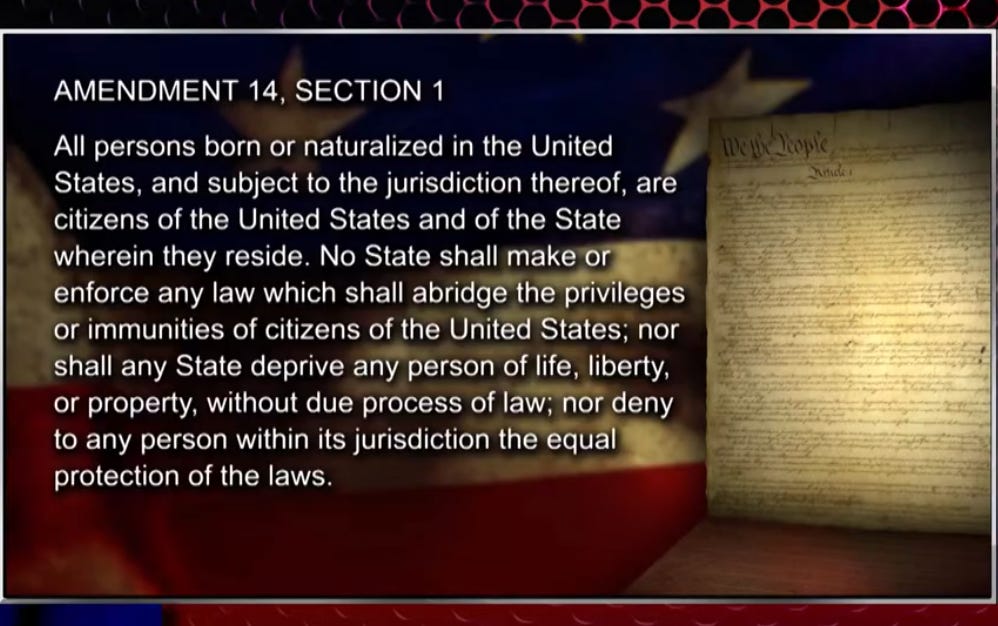
All persons born or naturalized in the United States, and subject to the jurisdiction thereof, are citizens of the United States and of the State wherein they reside. No State shall make or enforce any law which shall abridge the privileges or immunities of citizens of the United States; nor shall any State deprive any person of life, liberty, or property, without due process of law; nor deny to any person within its jurisdiction the equal protection of the laws.
Section 1. Purpose. The privilege of United States citizenship is a priceless and profound gift. The Fourteenth Amendment states: “All persons born or naturalized in the United States, and subject to the jurisdiction thereof, are citizens of the United States and of the State wherein they reside.” That provision rightly repudiated the Supreme Court of the United States’s shameful decision in Dred Scott v. Sandford, 60 U.S. (19 How.) 393 (1857), which misinterpreted the Constitution as permanently excluding people of African descent from eligibility for United States citizenship solely based on their race.
But the Fourteenth Amendment has never been interpreted to extend citizenship universally to everyone born within the United States. The Fourteenth Amendment has always excluded from birthright citizenship persons who were born in the United States but not “subject to the jurisdiction thereof.” Consistent with this understanding, the Congress has further specified through legislation that “a person born in the United States, and subject to the jurisdiction thereof” is a national and citizen of the United States at birth, 8 U.S.C. 1401, generally mirroring the Fourteenth Amendment’s text.
Among the categories of individuals born in the United States and not subject to the jurisdiction thereof, the privilege of United States citizenship does not automatically extend to persons born in the United States: (1) when that person’s mother was unlawfully present in the United States and the father was not a United States citizen or lawful permanent resident at the time of said person’s birth, or (2) when that person’s mother’s presence in the United States at the time of said person’s birth was lawful but temporary (such as, but not limited to, visiting the United States under the auspices of the Visa Waiver Program or visiting on a student, work, or tourist visa) and the father was not a United States citizen or lawful permanent resident at the time of said person’s birth.
Section Two
Representatives shall be apportioned among the several States according to their respective numbers, counting the whole number of persons in each State, excluding Indians not taxed. But when the right to vote at any election for the choice of electors for President and Vice-President of the United States, Representatives in Congress, the Executive and Judicial officers of a State, or the members of the Legislature thereof, is denied to any of the male inhabitants of such State, being twenty-one years of age, and citizens of the United States, or in any way abridged, except for participation in rebellion, or other crime, the basis of representation therein shall be reduced in the proportion which the number of such male citizens shall bear to the whole number of male citizens twenty-one years of age in such State.
Sec. 2. Policy. (a) It is the policy of the United States that no department or agency of the United States government shall issue documents recognizing United States citizenship, or accept documents issued by State, local, or other governments or authorities purporting to recognize United States citizenship, to persons: (1) when that person’s mother was unlawfully present in the United States and the person’s father was not a United States citizen or lawful permanent resident at the time of said person’s birth, or (2) when that person’s mother’s presence in the United States was lawful but temporary, and the person’s father was not a United States citizen or lawful permanent resident at the time of said person’s birth.
(b) Subsection (a) of this section shall apply only to persons who are born within the United States after 30 days from the date of this order.
(c) Nothing in this order shall be construed to affect the entitlement of other individuals, including children of lawful permanent residents, to obtain documentation of their United States citizenship.
Section Three
No person shall be a Senator or Representative in Congress, or elector of President and Vice-President, or hold any office, civil or military, under the United States, or under any State, who, having previously taken an oath, as a member of Congress, or as an officer of the United States, or as a member of any State legislature, or as an executive or judicial officer of any State, to support the Constitution of the United States, shall have engaged in insurrection or rebellion against the same, or given aid or comfort to the enemies thereof. But Congress may by a vote of two-thirds of each House, remove such disability.
Sec. 3. Enforcement. (a) The Secretary of State, the Attorney General, the Secretary of Homeland Security, and the Commissioner of Social Security shall take all appropriate measures to ensure that the regulations and policies of their respective departments and agencies are consistent with this order, and that no officers, employees, or agents of their respective departments and agencies act, or forbear from acting, in any manner inconsistent with this order.
(b) The heads of all executive departments and agencies shall issue public guidance within 30 days of the date of this order regarding this order’s implementation with respect to their operations and activities.
Section Four
The validity of the public debt of the United States, authorized by law, including debts incurred for payment of pensions and bounties for services in suppressing insurrection or rebellion, shall not be questioned. But neither the United States nor any State shall assume or pay any debt or obligation incurred in aid of insurrection or rebellion against the United States, or any claim for the loss or emancipation of any slave; but all such debts, obligations and claims shall be held illegal and void.
Sec. 4. Definitions. As used in this order:
(a) “Mother” means the immediate female biological progenitor.
(b) “Father” means the immediate male biological progenitor.
Section Five
The Congress shall have power to enforce, by appropriate legislation, the provisions of this article.
Sec. 5. General Provisions. (a) Nothing in this order shall be construed to impair or otherwise affect:
(i) the authority granted by law to an executive department or agency, or the head thereof; or
(ii) the functions of the Director of the Office of Management and Budget relating to budgetary, administrative, or legislative proposals.
(b) This order shall be implemented consistent with applicable law and subject to the availability of appropriations.
(c) This order is not intended to, and does not, create any right or benefit, substantive or procedural, enforceable at law or in equity by any party against the United States, its departments, agencies, or entities, its officers, employees, or agents, or any other person.
For historical backgrounds into each section of this amendment, CLICK HERE then click the Read the full text link in the lower portion of the page
More Evidence that Roberts and the LIBERAL Ladies failed to consider…
U.S. Code Definition of a Citizen