
Justice Alito's Dissent On Mail-in Ballots Is A Masterpiece And Nobody Is Talking About It

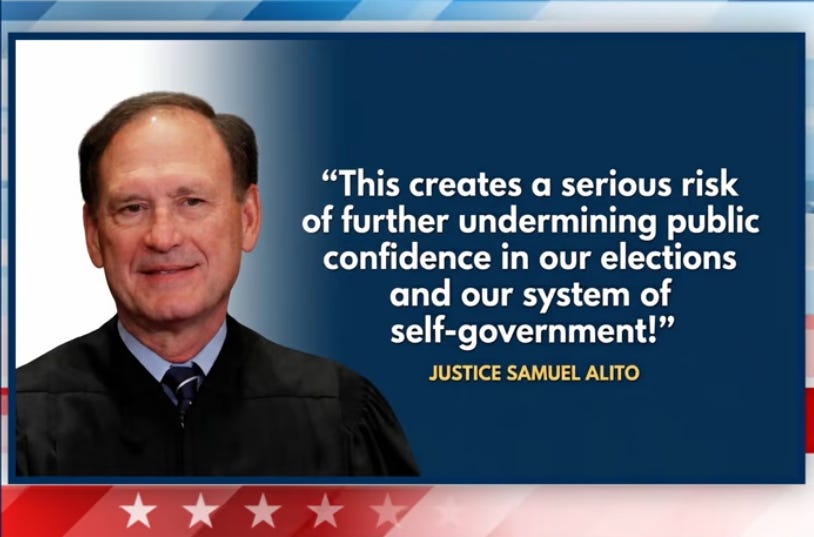
via Bill Mitchell on X; img credit: Kerri Lane
While the mainstream media is busy celebrating today's ruling, 4 justices stood in the breach and said what every honest American already knows.
Alito's dissent in Watson v. RNC is not just a legal argument.
It is a warning shot about where this country is headed if we do not get serious about election integrity.
Read these words carefully…
Alito wrote that when thousands of absentee ballots flow in after Election Day and potentially flip the result of an election, charges of a rigged election explode.
That is a sitting Supreme Court Justice, in an official dissent, validating what the corporate media has spent four years calling a conspiracy theory.
He went further…
Alito cited research showing that drawn-out ballot counting produces a large and significant decrease in Americans' trust in elections. Not a talking point. Not a campaign slogan. Peer reviewed research cited in a Supreme Court dissent. The problem is real, it is documented, and five justices just decided to ignore it.
On fraud, Alito was surgical…
He pointed out that as far back as 2005, a commission chaired by Jimmy Carter and James Baker concluded that absentee voting was the largest source of potential voter fraud in American elections. Jimmy Carter. The left canonizes that man. His own commission said mail-in ballots are the biggest fraud vulnerability we have. And today's majority just threw the door open wider.
Then Alito did something remarkable.
He painted a picture of exactly what this ruling could produce. A close presidential election. One state still counting. The leading candidate watching his margin shrink day after day as new batches of mail-in ballots arrive. The lead flipping with days to spare before electors must cast their votes. He was not writing fiction. He was describing something we have already watched happen in slow motion in race after race since 2020.
He also torched the majority's logic directly.
Barrett and Roberts argued that the word election in federal law only governs when voters CAST their ballots, not when officials RECEIVE them. Alito called this what it is. The electorate's choice is not complete, he argued, until all the ballots have been collected and the decision is fixed. A ballot sitting in a mail truck three days after Election Day is not a completed act of voting. It is an open question. And open questions are where fraud lives.
He also raised something nobody else is talking about.
What is the limiting principle here?
If states can accept ballots 5 days late, can they accept them twenty-one days late?
Washington State already does.
Can a state eliminate receipt deadlines entirely?
Alito asked that question directly and the majority gave no answer.
They opened a door and refused to say how far it swings.
Thomas and Gorsuch stood with Alito completely.
Kavanaugh joined most of it.
And Barrett, the justice we were told would hold the line, wrote the opinion that Alito was dissenting against.
History will not be kind to this decision.
But it may be very kind to this dissent.
The greatest dissents in Supreme Court history are often the ones that turn out to be right.
Alito, Thomas, and Gorsuch put it on the record today.
The question is what we do with it…