
You May Have Been Interpreting the Iran-Israel Conflict Backwards From the Very Beginning...

Our note: if your agree with Laura, you are thinking right… Be sure to follow our Promethean Updates Series posted on Mon, Wed, and Sat.
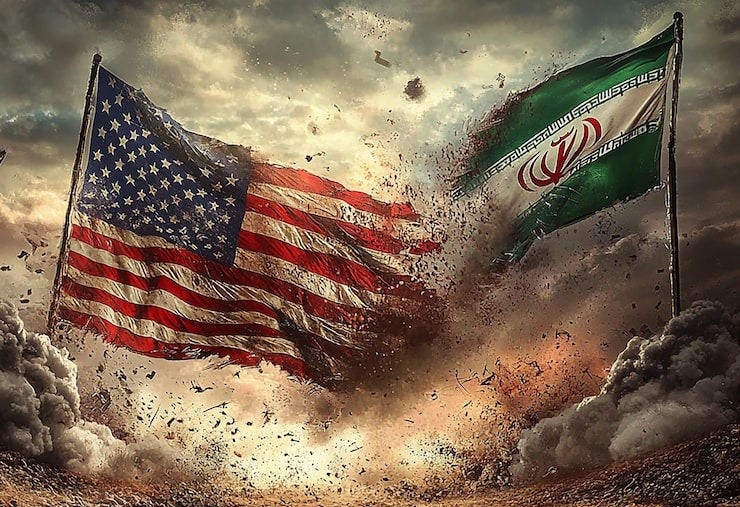
When this started, I wrote repeatedly that I did not believe this was really about Iran.
I always believed it was about Israel.
Not in the way most people assumed, but in the sense that the conflict itself would ultimately redefine Israel’s position in the region rather than strengthen it.
Now that the dust is beginning to settle, it is worth asking a simple question:
Who actually emerged stronger?
Because it certainly doesn’t look like Israel.
For decades we were told that Iran was the great threat, that it was perpetually weeks away from obtaining nuclear weapons, that military pressure and sanctions were necessary to contain it.
Yet after all the destruction, all the headlines and all the fear, Iran appears to have emerged with greater regional legitimacy, reduced isolation, renewed economic opportunities and a stronger diplomatic position than before.
Meanwhile Israel has suffered immense reputational damage.
The world watched Gaza, the world watched Lebanon, and the world is watching how Israel has increasingly come to be seen as a source of instability rather than security.
What if that was always where this was heading?
What if this conflict was never designed to destroy Iran, but to re-balance power across the region?
What if it was about creating a new regional order in which Israel could no longer act as the unchallenged military center of gravity?
What if it was about forcing Israel to accept limits?
What if it was about re-balancing power in the region before withdrawal?
Because at the same time, the United States appears to be steadily reducing its military footprint across the Middle East.
Several American bases have been damaged, abandoned or rendered strategically obsolete, and there is little indication that Washington intends to recreate the vast military architecture that defined the region for decades.
Instead, America’s strategic focus appears to be shifting back toward its own hemisphere.
Trump himself has openly embraced what is now commonly referred to as the “Donroe Doctrine”, a modern adaptation of the Monroe Doctrine, and JD Vance recently referenced the same concept.
The objective is clear: the Western Hemisphere comes first.
North America, the Caribbean, the Panama Canal, Greenland and America’s immediate sphere of influence have become the priority.
We saw it in Venezuela.
We are likely to see it in Cuba.
We see it in the campaign against narco-terrorist networks and in the renewed focus on securing America’s own neighborhood.
Viewed through that lens, the Middle East may no longer be the center of American grand strategy.
What we are witnessing is not expansion, but repositioning. Not a retreat from power, but a relocation of it.
A controlled transfer from direct military dominance to a new balance of regional powers.
It would also explain something many people have overlooked:
Why have Russia and China been relatively restrained
throughout this entire process?
Despite suffering economic consequences, neither Moscow nor Beijing appeared eager to intervene.
Perhaps because the broad contours of the outcome were already understood.
Perhaps the major powers had already negotiated where the lines would eventually be drawn.
After all, history is often decided in private rooms long before it appears on television screens.
What if the explosions were the theater
while the real negotiations happened elsewhere?
Because when I look at the final picture, I do not see an Israel that has expanded its influence.
I see an Israel that has been reminded that it is not the sole power in the region.
I see an Iran that has gained standing.
And I see a United States preparing to exchange direct control of the region for a new balance of power that no longer requires its permanent military presence.
I don’t think this war was about who would win. I think it was about deciding what the new balance would look like once it was over.
ADDENDUM
Our note: additional points not mentioned and we’ll present them in questions…
Who did Trump keep out of the involvement in his interaction with Iran? countries and organizations…
Who wanted to keep the Iran war going? countries and organizations…
Who did Trump keep involved in his interaction with Iran? countries and organizations…
What countries assisted with bringing the IRGC down?countries and organizations…
Leave your thoughts in the comments…